When a transmission starts slipping or grinding on a commercial truck, the instinct is to search fast and call the first shop that picks up. That urgency is completely understandable. But the difference between a qualified heavy-duty transmission specialist and a general auto shop that happens to accept trucks can mean the difference between a repair that lasts and one that fails again within weeks — at double the cost.
Most drivers and fleet operators have no easy way to evaluate whether a mechanic is actually qualified for this kind of work. This guide exists to change that. By the time you finish reading, you’ll know exactly what to look for — and what questions to ask before you commit to anyone.
Diesel Technician Certification: What It Actually Means for Transmission Work
The phrase “ASE certified” gets thrown around constantly in the truck repair world, and most people nod along without knowing what it actually covers. The truth is, ASE certification is not a single credential — it’s a structured system with separate tracks for different vehicle types and different systems within those vehicles. A mechanic who is certified to work on passenger car transmissions is not automatically qualified to work on a Class 8 semi.
For medium and heavy trucks specifically, ASE offers the T-Series — eight separate certification areas that cover everything from diesel engines to electrical systems to preventive maintenance. Each one requires passing a proctored exam. None of them can be completed fully online, regardless of what you might read elsewhere. When a mechanic tells you they have an “online ASE certification,” that’s worth a follow-up question.
The certifications are also time-limited. Every ASE credential expires after five years, which means a qualified technician has to recertify regularly to stay current. That matters more than it sounds, especially as truck technology has shifted toward automated manual transmissions that require a different diagnostic approach than older mechanical setups.

ASE T3 Drivetrain Certification: The One That Covers Truck Transmissions
If you want to know whether a mechanic is specifically qualified for truck transmission repair, the credential to ask about is the ASE T3 — the Drivetrain certification in the medium/heavy truck series. This is the exam that directly covers transmission diagnosis and repair, clutch systems, driveshafts, universal joints, and drive axles. It is not a general diesel certification. It is not a catch-all credential. It is the specific test that measures whether a technician understands how a commercial truck’s drivetrain actually works and what to do when it doesn’t.
The T3 exam includes questions specifically on transmission diagnosis and repair as one of its primary content areas, alongside clutch diagnosis. That might sound like a narrow distinction, but it matters enormously in practice. A mechanic who hasn’t studied drivetrain systems at this level is working from general experience, not verified competency. General experience can get you through a lot of repairs. It can also lead you to clear a fault code on a modern automated manual transmission without identifying the underlying cause — which means the truck comes back with the same problem, and now you’re paying for two repairs instead of one.
That’s not a hypothetical. Shops without the right diagnostic software and training for late-model AMTs routinely misidentify failure modes. The cost of a misdiagnosed transmission repair on a commercial truck isn’t just the incorrect repair — it’s the original bill, plus the return diagnostic, plus the correct repair. For a truck that’s off the road during all of that, the downtime cost alone can dwarf the repair itself.
The T3 is one of six certifications required to achieve ASE Master Medium-Heavy Vehicle Technician status — the highest credential tier in the field. Reaching that level requires passing T2 (Diesel Engines), T3 (Drivetrain), T4 (Brakes), T5 (Suspension and Steering), T6 (Electrical/Electronic Systems), and T7 (Heating, Ventilation and A/C). It’s a serious commitment, and not every shop can claim it.
ASE Diesel Certification Online: What's Real and What Isn't
One of the more common misconceptions floating around is that ASE diesel certifications can be earned entirely online. It’s an understandable assumption — a lot of professional credentials have moved to online formats in recent years. But ASE certification doesn’t work that way. The actual exams are proctored in person. Study materials, prep courses, and practice tests are available online, but they’re preparation for a real exam, not a substitute for it.
This matters when you’re evaluating a mechanic’s credentials. If someone claims their diesel certification came from an online course alone, what they’re describing is training — not certification. Training has value, but it isn’t the same thing as passing a standardized, proctored exam that measures specific competencies against a defined benchmark. One tells you someone sat through a course. The other tells you they can actually demonstrate the knowledge.
There’s also a separate tier worth knowing about: the ASE L2, which is an Advanced Level Electronic Diesel Engine Diagnosis Specialist certification. This one requires you to already hold a diesel engine certification — either A9, H2, S2, or T2 — before you can even sit for the exam. It’s a specialty credential that tests advanced diagnostic capability beyond what standard certification covers. For trucks with sophisticated electronic systems and modern AMTs, this kind of advanced diagnostic training is the difference between a technician who can read a code and one who can actually trace the root cause.
Manufacturer-specific certifications add another layer on top of all of this. Brands like Cummins, Caterpillar, and Detroit Diesel have their own training and credentialing requirements for mechanics working on their platforms. These are separate from ASE certifications and in addition to them — not a replacement. A shop that’s qualified to work on one OEM’s transmission may not be equally equipped for another. Asking which platforms a mechanic is trained on is a reasonable question, and a qualified technician will have a clear answer.
Diesel Mechanic Certifications and What Wayne County, MI Truck Operators Should Know
Wayne County puts unusual demands on commercial vehicles. The roads here are genuinely hard on drivetrains — the freeze-thaw cycle, the road salt, and the pothole conditions that Michigan drivers know well all accelerate wear on transmission components, seals, and housings in ways that don’t show up as quickly in warmer, better-maintained markets. Add the volume of commercial traffic moving through the area — from the automotive supply chain to the freight corridors near the Ambassador Bridge — and you have a market where transmission problems aren’t rare events. They’re a regular cost of doing business.
That context matters when you’re choosing who to call. A shop that handles mostly passenger cars can accept a truck and do their best. But best-effort isn’t the same as qualified, and in a market where trucks run around the clock and downtime has real financial consequences, the distinction is worth taking seriously.

What Makes a Mobile Truck Mechanic Qualified for Field Transmission Repairs
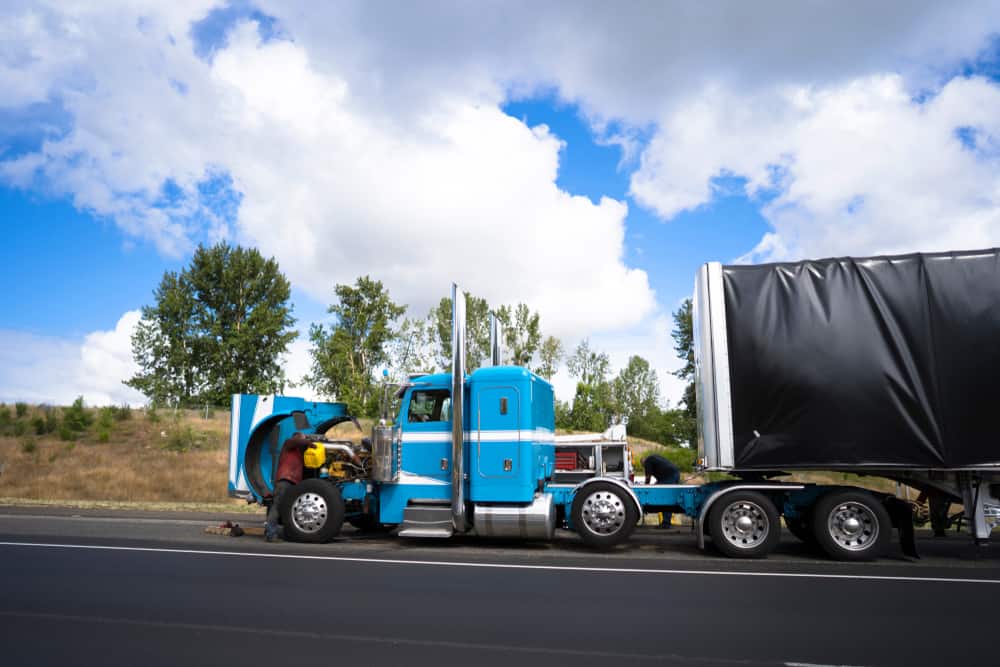
One question we hear regularly is whether a mobile mechanic can actually handle transmission work in the field — or whether that kind of repair requires a full shop setup. It’s a fair question, and the honest answer is: it depends entirely on the technician and how they’re equipped.
A mobile mechanic who arrives with the right diagnostic tools, the right parts inventory, and the training to use both effectively can complete many transmission repairs at the breakdown site. The key phrase there is “the right diagnostic tools.” For modern automated manual transmissions, a generic code reader isn’t sufficient. You need OEM-specific software that can actually communicate with the transmission control module, read live data, and identify failure modes accurately. Without that, you’re guessing — and guessing on a commercial truck transmission is expensive.
At J&J Truck & Trailer Repair, our lead mechanic is Dr. Phillip Marin, who holds three doctoral degrees in Diesel Engineering, Drivetrains, and Metal Alloys. That’s not a marketing line — it’s a level of academic and hands-on expertise that goes well beyond what any certification exam tests. Combined with over 40 years of field experience, Dr. Marin brings diagnostic depth that most shops, mobile or otherwise, simply can’t match. Our team arrives equipped to diagnose and complete repairs on-site, which means no tow, no shop drop-off, and no waiting around for a callback.
We’ve had customers tell us the estimate matched the final bill exactly — and that the job was done in 30 minutes. Those aren’t outcomes that happen by accident. They come from knowing what you’re looking at before you start the work.
How to Evaluate a Truck Transmission Shop Before You Commit
Most people only start thinking about this after something goes wrong. If your transmission is already slipping or you’re stranded on I-75 near the Ambassador Bridge at 2 AM, you don’t have time for a thorough vetting process. That’s exactly why it’s worth knowing what to look for before you need it.
The first thing to ask is whether the shop or technician holds the ASE T3 Drivetrain certification specifically. Not just “ASE certified” — that phrase is too broad to be useful. T3 is the credential that covers transmission and clutch diagnosis for medium and heavy trucks. It’s the benchmark. If a shop can’t tell you whether their technician holds it, that’s an answer in itself.
The second thing to ask is what diagnostic tools they use for late-model AMTs. If the answer is vague — “we have good equipment” or “we’ve worked on plenty of trucks” — push for specifics. A technician who is genuinely equipped for this work will be able to tell you exactly what software they use and which OEM platforms they’re trained on.
Third, ask whether they’ve worked on your specific truck make and transmission model before. Experience with one platform doesn’t automatically transfer to another. This is especially relevant in Wayne County, MI, where the automotive and logistics industries mean a wide variety of commercial vehicles are operating at any given time — from Ford and GM fleet trucks to Freightliner and Kenworth semis running the freight corridors.
Finally, ask about availability. If a shop only operates during business hours, that’s a real constraint for commercial operators who run at night, on weekends, or through holiday freight surges. A transmission failure at 6 AM on a Sunday in January is not a theoretical scenario in this market — it happens. Knowing ahead of time who will actually answer the phone matters.
We’re available 24 hours a day, seven days a week, and we serve Wayne County, MI and the surrounding Detroit metro area. If you’re trying to figure out whether we’re the right call for your situation, the fastest way to find out is to call us directly at 313-999-3088.
Finding the Right Truck Transmission Repair in Wayne County, MI
Credentials aren’t just paperwork. In the context of truck transmission repair, they’re the clearest signal you have that the person working on your vehicle actually understands what they’re dealing with. The ASE T3 Drivetrain certification sets a baseline. Master Medium-Heavy Vehicle Technician status raises it further. And a technician who combines academic depth with decades of field experience represents something you won’t find at most shops, mobile or otherwise.
Wayne County, MI’s roads, weather, and commercial traffic volume make this more than an abstract concern. Trucks here work hard, and transmissions feel it. When something goes wrong, the cost of choosing the wrong shop — in repeat repairs, in downtime, in missed deliveries — adds up fast.
If you want to talk through what’s going on with your truck or just want to know whether J&J Truck & Trailer Repair is the right fit for your situation, give us a call. We’re here around the clock, and we’ll give you a straight answer.