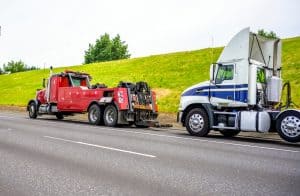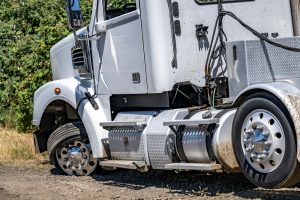
You set your trailer tires on a Friday afternoon, the gauge read what it should, and you went home. Monday morning the trailer is sitting in the yard with frost on the mirrors, and a couple of tires look a little soft. Nothing punctured them. The cold did it.
If you run freight through Wayne County or down into Monroe County, you’ve probably seen this and wondered if you have a leak or it’s just winter. Usually it’s winter, but that doesn’t make it harmless. Below, we cover how much pressure a Detroit-area cold night takes out of a trailer tire, why trailers get hit hardest, and how to handle it before a soft tire turns into a lost week.
How Much Does Truck Tire Pressure Drop In Cold Weather?
Cold air takes up less room, and your tires feel it right away. The usual rule for truck tires is a loss of about 1 to 2 psi for every 10°F drop in air temperature. Field data from Aperia Technologies, reported in TruckingInfo, ran higher. One tire went from 110 psi to 95 psi as the temperature fell 63°F, which works out to roughly 2.4 psi per 10 degrees.
Semi tires start much higher than a passenger car tire, so they have a lot more air to give up. Nothing is wrong with the tire when this happens. It’s physics, and it hits every tire on the trailer at the same time.
What Happens To A Trailer Parked Overnight When Detroit Drops To 20°F?
Here’s an example, not a reading from one particular truck. Say you set a tire to 100 psi on a 70°F afternoon. Detroit’s January lows average around 20°F, the highs sit near 32°F, and the worst nights can reach 6°F. A trailer that sits through a 20°F night has dropped 50 degrees. By the standard rule that’s roughly 5 to 10 psi gone, and closer to 12 using Aperia’s rate. You’re 5 to 12 percent under your target before there’s a single leak.
Now picture that trailer parked in a yard off the Lincoln Park industrial corridor, or in a lot near Romulus, over a long weekend. Nobody walks it. Each cold night pulls the pressure down to match the temperature, and on Monday someone hooks up and heads out.
The cold itself rarely blows a tire. The trouble starts when a low tire runs loaded, because it flexes more, builds heat and wears faster. CCJ reports industry research tying about 90 percent of tire failures to underinflation, and the ATA’s Technology & Maintenance Council estimates that 20 percent underinflation can shorten tire life by 30 percent. Cold also stiffens the bead. One driver on a trucking forum described a tire spinning on the rim at 25 psi in the cold. The first hard freezes of late fall and the deep-freeze weeks of January and February are when cold-related tire calls tend to pile up.
Why Do Trailer Tires Fail First When The Temperature Drops?
Mostly because nobody is watching them. A tractor gets a look every morning, while the trailer gets hooked up, rolled out and forgotten until something goes wrong. Many fleets don’t run an in-cab pressure monitor on trailers either, so a low tire can ride along for days.
Duals make it worse. When one tire in a pair runs lower than its partner, it turns at a smaller rolling radius and has to skip and drag to keep up. That wears both tires unevenly and costs you fuel. The inside dual is also the hardest one to reach with a gauge, so it’s the one that gets skipped.
The thump test won’t save you here. A tire expert quoted in CCJ said a tire bat finds only tires that are dead flat, and a tire 20 to 30 percent low can look and sound fine. Inspectors take tires seriously even if the bat doesn’t. In CVSA’s 2025 International Roadcheck, tires accounted for 2,899 out-of-service violations. That’s 21.4 percent of all vehicle out-of-service violations, second only to brakes. A tire at or below 50 percent of its sidewall maximum counts as flat.
Think about a trailer dropped in Monroe County on Friday and pulled north on I-75 on Monday, crossing into Wayne County. Same trailer, same load, same inspection exposure. The only difference is a couple of tires that were fine Friday and aren’t now.
Cold-Weather Trailer Tire Checks For Wayne County And Monroe County Drivers
The fix is boring, and that’s the good news. Check your trailer tires when they’re cold, meaning before the truck has moved, using a gauge you trust. TruckerGuide recommends at least once a week in winter, and the morning after a hard freeze is a smart time to add an extra check.
Check every tire, including the inside duals. Set each one to the pressure your load calls for, not a number somebody threw out at the fuel island. Extra air “just in case” doesn’t help, since it shrinks the contact patch. While you’re down there, look at the valve stems and the area where the bead meets the rim. Slow leaks like to hide in both.

Can I Add Air To My Truck Tires After A Run, Or Should I Wait Until They're Cold?
Wait if you can. Truck tire pressure specs, and the federal rule behind them, 49 CFR 393.75, are written around cold inflation pressure, which is the reading before the tire has been driven. Driving heats the air and pushes the number up. A tire that read 92 on a frosty morning can read 100 or more after a run up I-94 from Romulus. That higher number isn’t air you can count on. It’s heat, and it leaves when the tire cools.
That’s why the two worst habits are opposites. Topping up a warm tire to its cold target leaves it overfilled for now and wrong later. Bleeding a hot tire because the gauge reads high leaves it low on the next freezing morning. Fleet guidance is consistent on this: set pressure before the truck rolls, and leave a warm tire alone.
So how do you tell cold loss from a leak? Bring the tire up to spec, then check it again on a similar cold morning. If it’s down about what the temperature would explain, that’s weather. If it keeps falling, you’ve got a leak, and the usual suspects are the valve stem, the bead seal, the rim or a slow puncture.
One more thing worth knowing. The ATA has asked FMCSA to drop the vague underinflation clause in 393.75(h), arguing there’s no official definition of underinflated, and TruckingInfo reports more than 30,000 citations under it since 2012. The hard line is still 50 percent of sidewall maximum, but an inspector can write up a tire well above that. Spring flips the problem, with pressures climbing as the weather warms, so reset your numbers then too.
24 Hour Semi Tire Repair Near Me In Wayne County And Monroe County
If a tire is already down, the first rule is simple: don’t drive on it. A flat or badly low tire on a loaded trailer ruins the casing and can take the rim with it, and it’s an out-of-service item at inspection. Get off in a safe spot, and call us at 313-999-3088.
We’re J&J Truck & Trailer Repair, a family-owned shop on Kirkwood Street in southwest Detroit, and we’ve been working on trucks and trailers since the 1980s. Our dispatch sends the nearest service truck, most often within 10 to 15 miles. That truck carries air compressors, diagnostic computers, welding equipment and common parts, and we keep tires and rims in stock. We tow only when we can’t fix it on the spot.
Our rates are always the same. There’s no extra charge for nights, holidays or weekends, so 24 hour semi tire repair is priced like any other hour. Our ASE certified truck master mechanics work under Dr. Phillip Marin, who holds three PhDs in diesel engineering, drivetrains and metal alloys. They’ll tell you straight if a tire can be repaired or has to be replaced, and they’ll look at the brake, air line or hub that may have helped cause the trouble. We cover Wayne County and Monroe County, from Lincoln Park, Allen Park and Romulus down through Monroe, Carleton and Newport.
Get Your Trailer Tires Ready For The Next Michigan Cold Snap
Call J&J Truck & Trailer Repair today at 313-999-3088 for fast roadside semi tire repair and winter fleet maintenance anywhere in Wayne County or Monroe County.