You’ve already called two numbers. Neither one answered. Now you’re sitting on the shoulder of I-75 in the dark, wondering if “24/7 roadside assistance” is just something companies put on their websites.
It happens more than it should. The signs, the listings, the promises — and then nothing when it actually matters.
This page is for drivers who want to know what real 24 hour roadside assistance looks like before they need it, and for anyone in Wayne County, MI who’s already in that situation right now. We’ll walk you through what to expect, what questions to ask, and what actually separates a service that works from one that just claims to.
What "24 Hour Roadside Assistance" Actually Means — and Often Doesn't
The phrase gets used loosely. A lot of providers list themselves as 24/7 because they have an after-hours answering service — not because a real person with real equipment is actually available at 3 AM on a Sunday in January.
The difference matters enormously when you’re broken down. An answering service takes your information and says someone will call you back. That’s not roadside assistance. That’s a callback queue while you sit in the cold.
Genuine 24 hour roadside assistance means a trained mechanic — not just a tow driver — picks up the phone, gives you a realistic ETA, and shows up with the equipment to actually fix the problem. In Wayne County, MI, where winters are severe and commercial freight runs around the clock, that distinction is the entire ballgame.

Why Most Breakdowns Don't Have to End in a Tow
Here’s something a lot of drivers don’t realize until they’ve been through it: a breakdown doesn’t automatically mean a tow truck. It means that’s often the only tool a basic roadside provider has.
When a provider dispatches a tow driver — someone whose job is to hook up your vehicle and move it — that’s the outcome you’re going to get. Your truck gets hauled to a shop, possibly 30 or 40 miles away, and then you wait. For a shop to open. For a mechanic to assess the problem. For parts to be ordered. What started as a roadside issue becomes a two-day ordeal, and the cost climbs fast.
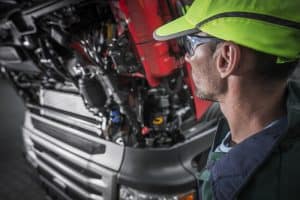
A mobile repair unit is a fundamentally different thing. It arrives carrying diagnostic computers, compressors, welding equipment, and common parts. The person stepping out of it isn’t there to hook up your vehicle — they’re there to figure out what’s wrong and fix it on the spot. That changes the entire outcome of the call.
Our mobile units are built around that philosophy. When we arrive, the goal is always to get you back on the road without a tow. That’s not always possible — some repairs genuinely require a shop — but in a lot of cases, it is possible, and most roadside callers never even know that option exists because the provider they called didn’t offer it.
For commercial operators running freight through Wayne County, MI, this matters in a way that’s hard to overstate. Every hour your truck sits idle has a cost attached to it — not just the service call, but the load, the delivery window, the customer relationship. A mobile repair that gets you moving in 30 minutes is a completely different financial outcome than a tow that takes most of the day.
One of our customers put it plainly in a review: the job was done within 30 minutes, and the estimate matched the final price. That’s the standard we hold ourselves to, because we know that’s what actually matters when you’re the one on the side of the road.
What to Look for Before You Call Any Roadside Provider
If you have a few minutes to evaluate your options — or if you’re reading this before you ever need to make that call — there are a few things worth checking.
First, ask whether a real person answers after hours. Not a service, not a callback system — an actual human who can dispatch help immediately. This is the single most important question, and most providers can’t honestly say yes.
Second, find out if they can handle your specific vehicle. This is especially critical for commercial drivers. A light-duty tow operator cannot safely recover a loaded semi-truck. If you’re running a tractor-trailer, a box truck, or any heavy commercial vehicle over 10,000 lbs, you need a provider with the right equipment — heavy-duty wreckers, rotator trucks — and the mechanical knowledge to match. Calling the wrong service doesn’t just waste time. It can create a dangerous situation on the roadway.
Third, ask about their diagnostic capability. A provider who can only tow will tow. A provider who carries diagnostic computers and repair equipment will try to fix the problem first. Those are two very different calls to make.
Fourth, get an estimate before work starts — and ask whether that estimate tends to hold. Price surprises in emergency situations are common and genuinely frustrating. A provider who gives you a number and sticks to it is worth more than one who quotes low and adjusts upward once your truck is already on their hook.
Finally, look for specificity in their experience. “Experienced mechanics” means nothing. What brands do they work on? What systems? Our team works on Freightliner, Peterbilt, Kenworth, Volvo, International, Mack, Cummins, Detroit Diesel, and more — because Wayne County’s freight corridors see all of them, and we’ve built our capability around that reality.
Cheap Roadside Assistance: What It Really Costs You
“Cheap” is a word that needs context in this industry. A low-cost service that only tows your truck to a closed shop 40 miles away isn’t cheap — it’s expensive in a way that doesn’t show up on the initial invoice.
The real cost of a breakdown is downtime. It’s the load you don’t deliver, the customer you have to call with bad news, the driver sitting in a truck stop waiting for a shop to open. When you frame it that way, a mobile repair service that fixes the problem roadside — even if the service call costs more upfront — is almost always the more economical outcome.
We’re not the cheapest number in the phone book, and we don’t try to be. What we offer is transparency: an estimate before we start, and a final price that matches it. That’s what fair actually looks like.
Roadside Service for Semi Trucks: Why It's a Different Category Entirely
If you drive a semi or manage a commercial fleet, you already know that most roadside assistance services aren’t built for you. They’re built for passenger cars and light trucks. The equipment is different, the diagnostic knowledge is different, and the stakes are completely different.
A semi-truck breakdown on I-94 near Dearborn or on I-96 through Livonia isn’t just an inconvenience — it’s a safety issue, a liability issue, and a logistics problem all at once. The vehicle is large, it may be loaded, and it’s sitting in a lane or on a shoulder where every passing truck creates risk. You need someone who arrives with the right equipment and the right knowledge, fast.
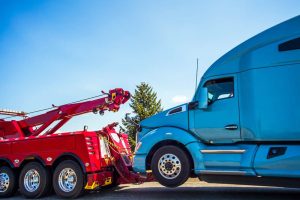
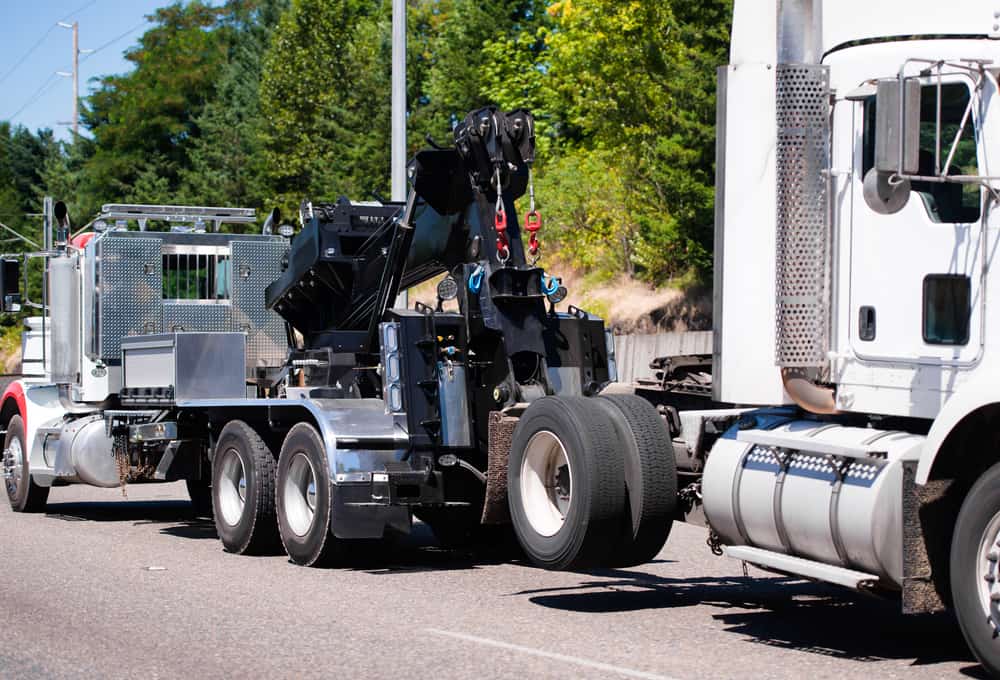
We provide heavy-duty roadside service for commercial vehicles throughout Wayne County, MI. Our fleet includes heavy-duty wreckers and rotator trucks specifically designed for Class 8 vehicles. Our lead mechanic, Dr. Phillip Marin, holds three Ph.D. degrees — in Diesel Engineering, Drivetrains, and Metal Alloys — which means the person diagnosing your truck has a level of formal expertise that’s genuinely rare in this space. When other services tell you it needs to be towed, we’re often able to get you running again on the spot.
We work on the full range of commercial truck brands — Freightliner, Peterbilt, Kenworth, International, Volvo, Mack, Western Star, Hino, and more. We also handle reefer units from Thermo King and Carrier, ABS diagnostics, forced regens, DEF services, DOT inspections, and engine work on CAT, Cummins, Detroit Diesel, and Volvo powerplants. For fleet managers, that breadth matters — you shouldn’t need a different vendor for every system.
Wayne County’s freight volume is significant. Between the Ambassador Bridge corridor, Detroit Metro Airport cargo operations in Romulus, and the industrial concentration in Dearborn and surrounding communities, commercial trucks are moving through this county at all hours. When one of them goes down, the clock starts immediately. We answer that clock.
Tractor Trailer Roadside Assistance: Covering the Whole Rig, Not Just the Cab
One thing that catches drivers off guard: a lot of roadside providers will help with the tractor but have no capability when the problem is in the trailer. That’s a meaningful gap. Trailer issues — blown tires, lighting failures, brake problems, reefer malfunctions, structural damage — are common, and they can put you out of service just as effectively as an engine failure.
Our tractor trailer roadside assistance covers the full rig. We work on trailer brands including Utility, Great Dane, Manac, and Hyundai, and our mobile units are equipped to handle the most common trailer-side failures on the road. If your reefer unit goes down on a temperature-sensitive load, that’s not a “wait until morning” situation — we understand that, and we respond accordingly.
Michigan winters add a layer of complexity that drivers from other regions sometimes underestimate. Wayne County, MI averages 31 inches of snow annually, with temperatures that regularly drop below zero in January and February. Cold weather accelerates battery failures, causes diesel fuel to gel, drops tire pressure, and creates starting failures across the board. One of our customers called us at 6:30 AM on a Sunday in 7-degree weather — we drove 40 miles to reach them, diagnosed the problem, and had them back on the road after replacing the batteries and alternator. That’s not an unusual call for us. Michigan winters are part of the job.
The freeze-thaw cycles that make Michigan roads some of the worst in the country also mean elevated rates of tire blowouts and suspension damage — especially in Wayne County, MI, where heavy commercial traffic compounds road deterioration. If you’re running I-75, I-94, or I-96 regularly, you’ve probably already felt what that road surface does to a loaded trailer. We’ve seen the results of it more times than we can count, and we know how to handle it.
If you’re broken down right now, or if you want to have a number saved before you ever need it, call us at 313-999-3088. Real people answer, around the clock.
Who to Call for 24 Hour Roadside Assistance in Wayne County, MI
Real 24 hour roadside assistance isn’t about the sign on the website. It’s about who actually answers at 2 AM, what they show up with, and whether they can fix the problem instead of just moving it somewhere else.
We’ve been doing this since 1999. Family-owned, Wayne County, MI-based, and built around the idea that a breakdown should be a temporary problem — not a two-day ordeal. Dr. Marin and the team bring over 40 years of hands-on experience to every call, and our mobile units are equipped to handle everything from a jump-start to a diesel engine repair on the shoulder of a major interstate.
If you’re evaluating your options, we hope this gave you a clearer picture of what to look for. And if you’re ready to talk to someone, J&J Truck & Trailer Repair is reachable at 313-999-3088 — any hour, any day.