
If you’ve ever been stuck on the side of I-94 in January, watching trucks blow past you at 70 miles an hour, you already know the feeling. You need help, you need it fast, and you’re not exactly in a position to comparison shop. That’s exactly the moment some operators in Wayne County count on.
Wayne County has a documented history of predatory towing, and the Michigan Attorney General’s office has reissued consumer alerts about it as recently as July 2025. Before the next breakdown happens, it’s worth knowing what you’re actually entitled to—and what to look for in the provider you call.
What Michigan Law Actually Says About Roadside Assistance
Here’s something most drivers in Wayne County, MI don’t know: Michigan law gives you the legal right to request the roadside assistance provider of your choice when law enforcement is present at a breakdown scene. That right is codified under MCL 257.676c, and it exists specifically to protect you from being handed off to a tow operator you didn’t choose and didn’t vet.
The Michigan AG’s office has been vocal about this. In July 2025, Attorney General Dana Nessel reissued a formal consumer alert on Michigan towing laws—following a presentation directly to the City of Detroit Board of Police Commissioners Towing Committee. Detroit Police have publicly confirmed they’ve barred tow companies for not following the fee schedule. This isn’t a hypothetical problem. It’s a documented one happening in your backyard.
The law also gives you the right to challenge whether your vehicle was properly towed and whether the fees charged were reasonable. You don’t have to accept whatever number appears on the invoice.
How Predatory Towing Actually Works—and How to Spot It
The pattern is consistent. A breakdown happens, and within minutes a tow truck appears that you never called. The driver is in a uniform, the truck looks professional, and they’re moving quickly—because speed is part of the tactic. By the time you realize you didn’t choose them, your vehicle is already hooked up.
From there, the leverage shifts entirely to the operator. Storage fees start accumulating. The final bill looks nothing like what was mentioned at the scene. And because you’re stressed, your cargo is late, and you just want your truck back, you pay it.
The Michigan AG’s consumer alert specifically warns against accepting tow trucks that “just show up” after a breakdown or accident. Fake branding, convincing uniforms, and professional-looking equipment are all documented tactics. None of that tells you whether the operator is credentialed, fairly priced, or even capable of handling your specific vehicle.
Michigan has no mandatory licensing or certification requirements for tow truck operators. That means the person responding to your breakdown call could have zero formal training and still legally operate. In that environment, credentials aren’t just a nice-to-have—they’re the only real signal of quality you have.
ASE certification, named technicians, verifiable reviews, a physical address, and a stated pricing policy are the things worth looking for. A truck that shows up uninvited has none of those things working in your favor. When you have a provider’s number already saved—one you’ve looked up, checked reviews on, and confirmed can handle your vehicle—you’re not making a panicked decision at the side of the road. You’re making a call.
What Credentials Actually Mean When You're Choosing a Roadside Provider
Because Michigan sets no mandatory bar for tow operators, credentials in this industry are entirely voluntary. Which means the operators who pursue them are making a deliberate choice to be held to a higher standard than the law requires.
ASE certification—specifically the Truck Master Technician designation—requires passing all eight medium and heavy truck tests. It’s the recognized benchmark in the industry, and it’s not easy to earn. When a provider says they’re ASE certified truck master mechanics, that’s a verifiable claim with real weight behind it.
Beyond certification, there’s the question of diagnostic capability. A basic tow operator can hook up your truck and move it. A qualified mobile repair specialist can connect to your truck’s onboard computer, read the fault codes, identify the problem, and—if they’ve stocked the right parts—fix it on the spot.
For commercial operators running freight on I-94 or I-75 through Wayne County, MI, the difference between those two outcomes isn’t just convenience. Industry estimates put commercial truck downtime costs at $448 to $760 per hour in lost productivity and potential delivery penalties. A provider who fixes your truck in 30 minutes on the side of the road is worth something fundamentally different than one who tows it to a shop and tells you to wait for a part.
What to Look for in Roadside Service Truck Companies Before You Need One
The best time to evaluate a roadside provider is before your truck breaks down—not while you’re standing on the shoulder of I-275 in February with your hazards on. The providers worth calling have a few things in common, and none of them are hard to verify in advance.
Look for named technicians, not just a company name. A business where a specific, credentialed person is accountable for the work is a different animal than a dispatch app routing your call to whoever’s available.
Look for reviews that mention specific details—response times, whether the estimate matched the final bill, whether the tech arrived prepared to fix rather than just tow. And look for an explicit pricing policy, particularly around nights, weekends, and holidays, because that’s where a lot of operators quietly add fees.
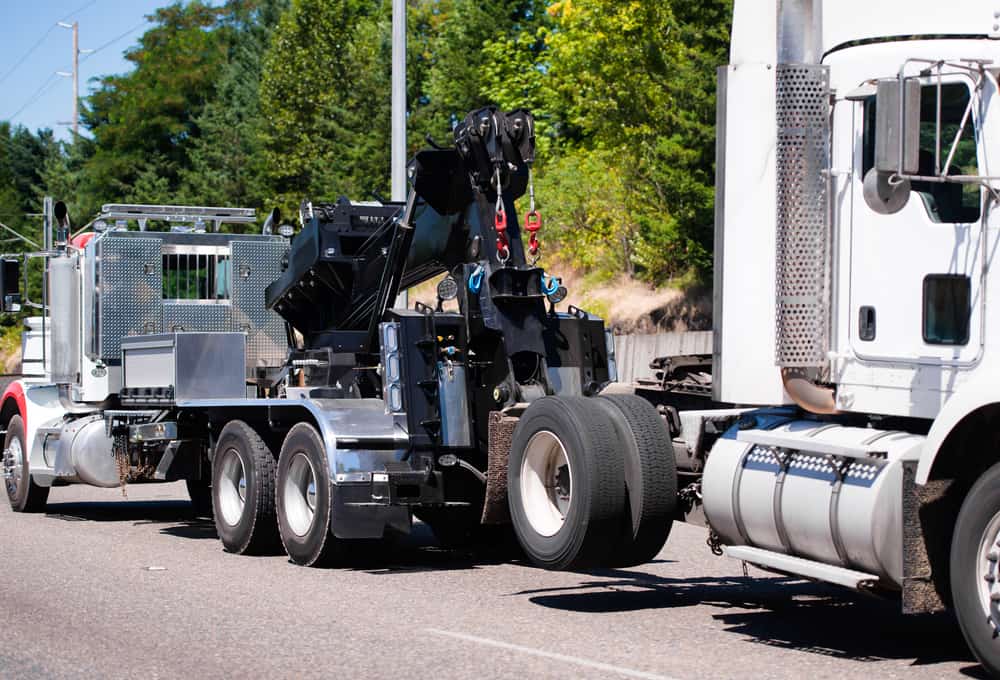
What Makes a Roadside Service Truck Actually Useful vs. Just Available
Availability is table stakes. Every provider in Wayne County claims to be 24/7. What matters is what shows up when they arrive.
A genuinely equipped roadside service truck carries diagnostic computers capable of reading fault codes across major commercial truck brands—Freightliner, Kenworth, Peterbilt, Volvo, Mack, International, Western Star. It carries common wear parts: belts, hoses, filters, fuses, basic electrical components. It carries tire repair equipment, drive shafts, and the tools to handle brake work, ABS diagnostics, and fuel system issues on the spot.
When a mobile unit arrives stocked like that, the conversation is “here’s what’s wrong and here’s how we fix it right now”—not “we’ll need to tow it and order a part.”
That distinction matters most in Wayne County, MI’s commercial corridor. This county is home to Ford’s global headquarters in Dearborn, major logistics hubs around Detroit Metro Airport in Romulus, and one of the nation’s busiest freight routes along I-94. The density of semi-trucks, box trucks, and fleet vehicles operating here is genuinely higher than most U.S. counties. When one of those vehicles goes down, the clock starts immediately.
We carry the most common parts on every call—stocked 99% of the time according to our experience. When our mobile unit rolls out to your location, the goal is to get you moving again without a tow. That’s not always possible, but it’s what we’re set up to do, and it’s what separates a mobile repair operation from a tow-first service that happens to answer the phone.
Box Truck Roadside Assistance: The Gap Most Wayne County Providers Won't Tell You About
Box trucks occupy an awkward middle ground in the roadside assistance market. At Class 3 through Class 6—vehicles between 10,001 and 26,000 lbs GVWR—they’re too heavy for most light-duty providers to handle safely, but they’re not always the priority for heavy-duty operators focused on semi-trucks and full-size trailers. The result is a segment that’s genuinely underserved, and if you’ve ever tried to find box truck roadside assistance in Wayne County, MI on short notice, you’ve probably felt that gap firsthand.
We handle both sides of the weight line. Under 10,000 lbs and over—passenger vehicles, box trucks, semi-trucks, trailers, motor homes, and everything in between. That breadth matters for fleet operators running mixed vehicle types, and it matters for owner-operators who can’t afford to call three different services before finding one that can actually help.
Wayne County’s delivery economy is substantial. The logistics activity around DTW, the distribution centers along I-94 and I-275, and the last-mile delivery traffic running through Romulus, Dearborn, and Westland all depend heavily on box trucks. When one of those vehicles breaks down on a delivery route, the driver needs someone who can show up, diagnose the problem, and fix it—not someone who’ll arrive, look at the vehicle, and say it’s outside their capability.
Our team is led by Dr. Phillip Marin, who holds three Ph.D. degrees in Diesel Engineering, Drivetrains, and Metal Alloys. That level of credential is unusual in any context, and it’s essentially unheard of in mobile roadside assistance. Combined with ASE certification and over 40 years of hands-on experience, it means the person diagnosing your box truck actually understands what’s happening at a mechanical level—not just what the fault code says.
We’ve been family-owned and operated since 1999, working out of Detroit at 8332 Kirkwood St. When you call 313-999-3088, you’re reaching a real operation with a real address and real accountability—not a dispatch center routing your call to the nearest available contractor.
Choose Emergency Roadside Assistance in Wayne County Before You Need It
Michigan law gives you the right to choose your provider. Predatory operators in this market count on you not knowing that—or not having a number ready when it matters.
The answer isn’t complicated: find a provider with verifiable credentials, named technicians, a clear pricing policy, and the equipment to actually fix your vehicle on-site. Check their reviews for specifics. Confirm they can handle your vehicle class. Save the number before the breakdown happens.
If you’re in Wayne County, MI and you need a provider you can trust with a semi, a box truck, a trailer, or a passenger vehicle—day or night, holiday or not—J&J Truck & Trailer Repair is the call worth making. Reach us at 313-999-3088.