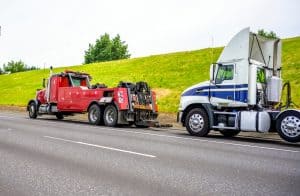

It’s 6:30 in the morning. It’s January. You turn the key and get nothing. Whether you’re sitting in a parking lot in Westland or on the shoulder of I-75 Downriver, a dead battery is one of those problems that has a way of making everything else feel worse. The good news is that most dead batteries are fixable — quickly, and without a tow. The more important news is that how you fix it depends entirely on what you’re driving. Jump-starting a passenger car and jump-starting a semi truck are not the same job, and treating them like they are can cause serious damage. Here’s what you actually need to know.
Why Car Batteries Die — Especially in Michigan Winters
Cold weather is the single biggest enemy of a car battery. When temperatures drop below freezing, a battery can lose roughly a third of its starting power — and in a Michigan winter, that’s not a rare edge case, it’s a Tuesday in January. Wayne County regularly sees the kind of sustained cold snaps and freeze-thaw cycles that wear batteries down faster than almost anywhere else in the continental US.
What makes it worse is that cold weather increases the engine’s demand at exactly the moment the battery has less to give. The oil thickens, the engine needs more cranking force, and the battery is already running at reduced capacity. That combination is why battery failure accounts for nearly half of all vehicle breakdowns — it’s not bad luck, it’s physics.
Batteries weakened by summer heat are especially vulnerable. A battery that barely made it through August is often the one that finally gives out on the first hard freeze of November. If your car has been slow to start on cold mornings, that’s not something to ignore.

How to Jump Start a Car Safely — Step by Step
If you have a set of jumper cables and a working vehicle nearby, a standard passenger car jump-start is something most drivers can handle on their own. The process is straightforward, but the order matters — skipping steps or reversing the sequence can cause sparks, damage your vehicle’s electronics, or in rare cases create a hazard near the battery itself.
Start by parking the working vehicle close enough that the cables can reach both batteries without stretching, but make sure the two vehicles aren’t touching. Turn off the working car before you connect anything. Then connect the red (positive) cable to the positive terminal on the dead battery first, followed by the other end of the red cable to the positive terminal on the good battery.
Next, connect the black (negative) cable to the negative terminal on the good battery — and here’s the step people often get wrong — connect the other end of the black cable to an unpainted metal surface on the dead vehicle, not to the dead battery’s negative terminal. This reduces the risk of igniting any hydrogen gas that may have accumulated near the battery.
Once everything is connected, start the working vehicle and let it run for a few minutes. Then try starting the dead vehicle. If it starts, leave it running for at least 15 to 20 minutes to give the alternator time to recharge the battery. When you disconnect, reverse the order: black cable from the grounded metal surface first, then black from the good battery, then red from the good battery, then red from the previously dead battery.
If the car starts but dies again within an hour or two, the battery isn’t the only thing to look at. A failing alternator won’t recharge the battery while you drive, which means you’ll be right back where you started. A proper diagnosis — not just a jump — is what actually solves the problem.
What to Do If Your Car Still Won't Start After a Jump
A jump-start that doesn’t work isn’t always a sign that the battery is completely dead. Sometimes it means the battery has deteriorated past the point where a surface charge will hold, and sometimes it means the problem was never the battery to begin with. A bad alternator, a parasitic drain from a faulty electrical component, or corroded terminals that are blocking the connection can all produce the same symptom — a car that won’t start — but require completely different fixes.
If the engine cranks weakly and then stops, the battery probably has some life left but not enough to fire the engine. Letting the donor vehicle run longer before attempting the start can sometimes help. If you get nothing at all — no cranking, no clicking, just silence — the issue may be a connection problem rather than a dead battery. Check that the cable clamps are making solid contact with clean metal, not corrosion buildup.
If the car starts but the battery warning light comes on while you’re driving, that’s your alternator telling you it’s not doing its job. Pull over somewhere safe rather than trying to make it home, because once the alternator stops charging, you’re running entirely on whatever charge is left in the battery — and that runs out faster than most people expect.
For Wayne County drivers who find themselves in this situation on a major route like I-94 or I-96, the safest move is to call for help rather than risk losing power in traffic. A mobile mechanic who can diagnose the actual cause on-site will save you more time and money than a tow to a shop that may not be able to see you for hours.
Why Jump-Starting a Semi Truck Is a Completely Different Job
This is the part that most roadside guides skip entirely — and it’s the part that matters most if you’re a commercial driver or fleet operator in Wayne County.
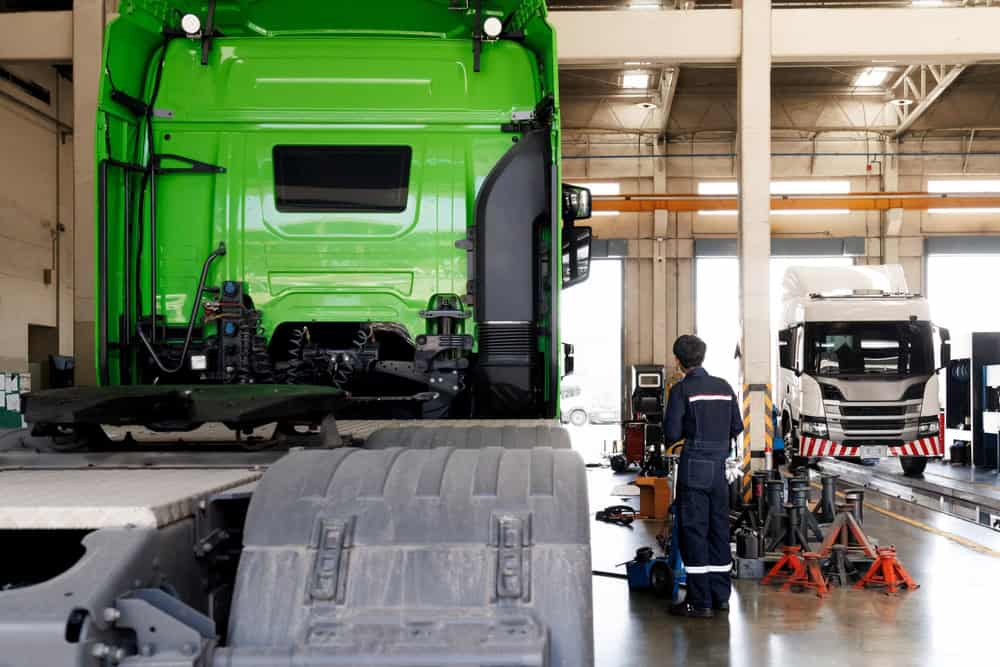
Most Class 7 and Class 8 semi trucks run on a 24-volt electrical system, not the 12-volt system in your passenger car. They get there by wiring two 12-volt batteries in series, which doubles the voltage. That means a standard car jump starter, and in many cases a standard set of jumper cables connected to a passenger vehicle, simply cannot deliver what a commercial truck needs to start. Worse, connecting a 12-volt source incorrectly to a 24-volt system can damage the truck’s ECU and electrical components — turning a dead battery call into a repair bill that runs into the thousands.
How Many Amps Does It Take to Jump Start a Semi Truck?
The short answer is: a lot more than your car needs. A typical passenger car requires somewhere between 400 and 600 cold cranking amps to start. A semi truck — especially a diesel engine sitting in a Wayne County parking lot after an overnight in sub-zero temperatures — can require 1,500 to 2,000 or more cold cranking amps just to turn over.
Diesel engines don’t use spark plugs. They rely on compression heat to ignite the fuel, which means the engine has to crank harder and longer before it fires. That places enormous demand on the battery system right at startup, and it’s why a consumer-grade jump pack from an auto parts store is simply not rated for the job. The equipment that handles a semi-truck jump-start is commercial-grade, 24-volt-rated, and built specifically for this application.
There’s also the wiring configuration to consider. Some trucks wire their dual batteries in parallel rather than series — same voltage, but doubled amp-hour capacity. A technician who doesn’t know which configuration they’re working with before they connect anything can cause real damage. This is not a situation where figuring it out as you go is acceptable.
For the owner-operators and fleet drivers who run the I-75 and I-94 corridors through Wayne County — including the freight routes near Detroit Metropolitan Wayne County Airport in Romulus and the Ambassador Bridge approach — a breakdown means time, money, and potentially a missed delivery window. The difference between calling a service that understands commercial vehicle electrical systems and calling one that doesn’t is not a small thing.
What to Look for in a Commercial Vehicle Jump-Start Service in Wayne County
Not every roadside service that advertises jump-starts is equipped to handle a commercial truck. Most are set up for passenger cars and light-duty vehicles, and there’s nothing wrong with that — until a semi driver calls expecting help and gets someone who shows up with the wrong equipment and no idea what they’re looking at.
When you’re evaluating who to call for a commercial vehicle jump-start in Wayne County, a few things actually matter. First, does the service carry commercial-grade, 24-volt-rated equipment? If they can’t answer that question directly, that’s your answer. Second, are the mechanics actually trained on diesel systems and commercial vehicle electrical configurations, or are they general-purpose technicians who handle whatever comes in? The difference is significant when you’re dealing with a dual-battery system on a Freightliner or a Peterbilt.
Third — and this one matters more than most people think — can they diagnose the underlying cause on-site, or will they just jump the truck and send you on your way? A jump that doesn’t address a failing alternator or a battery that’s past its service life will leave you stranded again within hours. A service that carries diagnostic equipment, common parts, and the expertise to use them can often resolve the actual problem right there, without a tow.
We at J&J Truck & Trailer Repair hold ASE Truck Master Mechanic certification — the highest designation in the industry for heavy-duty vehicle technicians. Our lead mechanic, Dr. Phillip Marin, holds three Ph.D. degrees in Diesel Engineering, Drivetrains, and Metal Alloys. We serve both light-duty and heavy-duty vehicles across Wayne County, and our mobile units are equipped to handle more than a jump-start if the situation calls for it. We don’t charge extra for nights, weekends, or holidays — the rate we quote is the rate you pay. We’re available 24/7 at 313-999-3088.
If you’re a commercial driver who’s been through a bad roadside experience before, you already know why credentials and equipment matter. If you haven’t — consider this the thing you read before you needed it.
Dead Battery in Wayne County? Here's What to Do Next
A dead battery is rarely the end of the world — but it can become a much bigger problem if it’s handled wrong. For passenger car drivers, knowing the correct jump-start sequence and recognizing when a jump isn’t enough can save you a lot of time and a second breakdown. For commercial drivers, understanding that your truck’s electrical system is fundamentally different from a car’s — and that it requires equipment and expertise to match — is the kind of knowledge that protects both your rig and your schedule.
Wayne County winters don’t give much warning. The first hard freeze of the season has a way of revealing every battery that was already on its way out. Whether you’re commuting through Dearborn, running freight Downriver, or sitting at a loading dock in Romulus at 4 AM, it helps to know who to call before you need to make the call.
We’re here around the clock. Call J&J Truck & Trailer Repair at 313-999-3088 if you’re stranded or just want to save our number for the next time you need it.