Every hour a semi sits idle costs money. Not a little money — industry data puts unplanned downtime at around $760 per hour in lost productivity, missed deliveries, and cascading delays. And yet most owner-operators don’t think seriously about repair until they’re already stranded. By then, the options narrow fast and the leverage disappears.
This guide is for the driver who wants to get ahead of that moment. We’ll walk through what semi truck repair actually covers, what to look for in a mechanic, and why having a trusted number saved before something breaks is one of the smartest calls you can make.
What Does Semi Truck Repair Actually Cover?
“Semi truck repair” is a broad term that gets used to describe everything from a tire swap to a full engine overhaul. In practice, it covers several distinct systems — and each one requires a different level of expertise to diagnose correctly.
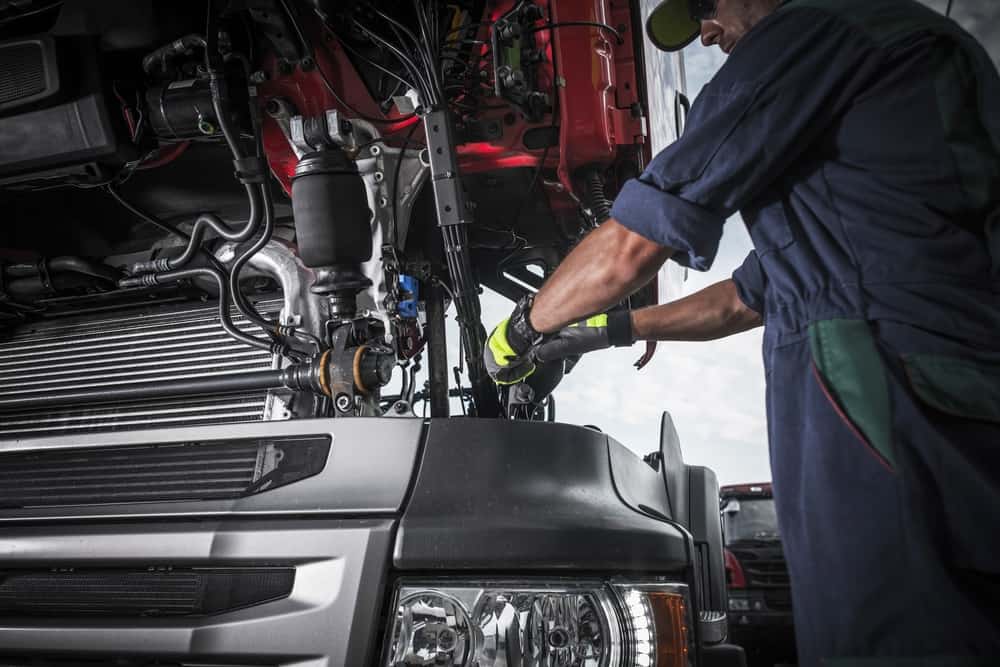
The most common areas include diesel engine diagnostics, air brake systems, drivetrain and transmission work, electrical troubleshooting, and DOT compliance inspections. Beyond those, there’s reefer unit repair for temperature-controlled loads, fuel system issues, ABS diagnostics, differential service, and turbocharger problems. A mechanic who’s genuinely qualified to work on a Class 8 truck needs to be competent across all of it — or at least honest about where their knowledge ends.

Why Diesel Engine and Drivetrain Diagnosis Is More Complicated Than Most People Realize
A diesel engine isn’t just a bigger version of what’s under the hood of a pickup. The fuel injection systems, turbocharger dynamics, and emissions controls on a modern Class 8 truck are genuinely complex — and when something goes wrong, the fault codes a scanner pulls don’t always tell the whole story. A code points to a symptom. Figuring out the root cause takes real diagnostic depth.
Drivetrain problems are even trickier. Transmissions, drivelines, and differentials operate under enormous stress loads, and the failure modes aren’t always obvious. A truck that slips under load, vibrates at highway speed, or loses power on grades might have a transmission issue — or it might be something upstream in the engine, something in the clutch, or a combination of factors working together. Misdiagnose it and you replace the wrong part, spend money you didn’t need to spend, and end up broken down again 200 miles later.
This is why credentials actually matter in this space. Not every mechanic who calls themselves a diesel tech has the diagnostic background to work through a complex drivetrain problem methodically. The difference between a mechanic who replaces parts until something works and one who actually understands what’s happening inside the system is the difference between a $400 repair and a $4,000 one.
Our lead mechanic, Dr. Phillip Marin, holds three Ph.D. degrees — in Diesel Engineering, Drivetrains, and Metal Alloys. That’s not a credential you see anywhere else in mobile truck repair in the Detroit area. When we show up to a breakdown, we’re diagnosing from first principles, not guessing. Combined with ASE Master Mechanic certification — the highest designation in the trade — that’s a level of expertise that most shops, mobile or otherwise, simply can’t match.
Air Brakes, DOT Inspections, and the Repairs That Keep You Legal
Brake problems are the leading cause of out-of-service violations during roadside DOT inspections. In Wayne County, where road salt accelerates corrosion on brake chambers, air lines, and slack adjusters, those problems tend to develop faster than they would in a drier climate. A truck that passed inspection in the fall can have legitimately compromised brake components by spring — not because the driver did anything wrong, but because Michigan winters are hard on everything underneath the frame.
An out-of-service order isn’t just an inconvenience. It pulls the truck off the road immediately, and the fines for serious violations can reach $7,500 or more. Beyond the fine, there’s the cost of getting the truck towed to a shop, the repair itself, and the loads you miss while it’s sitting. The math adds up quickly.
Complete air brake service covers more than just pad replacement. A thorough inspection includes brake adjustment, rotor condition, ABS system function, air line integrity, and chamber condition — all the components that FMCSA regulations require to be in working order. DOT inspections, done right, catch these issues before an enforcement officer does.
We handle complete DOT inspections and air brake system repairs as part of our mobile service throughout Wayne County. We can come to your yard, your staging area, or your breakdown location and work through the full system — no tow required in most cases. For fleets running routes along I-94, I-75, or I-96, having a mechanic who can handle brake compliance work on-site is a real operational advantage, not just a convenience.
What to Look for in a Semi Truck Mechanic
The trucking community has a long memory for bad mechanics. A shop that replaces parts without diagnosing the problem, quotes one price and charges another, or can’t handle the job they claimed they could — word gets around. And when you’re stranded at 3am on a Sunday near the Ambassador Bridge with a load that has to clear customs, you don’t have time to vet someone from scratch.
Knowing what to look for before you need it is the whole point of this guide.
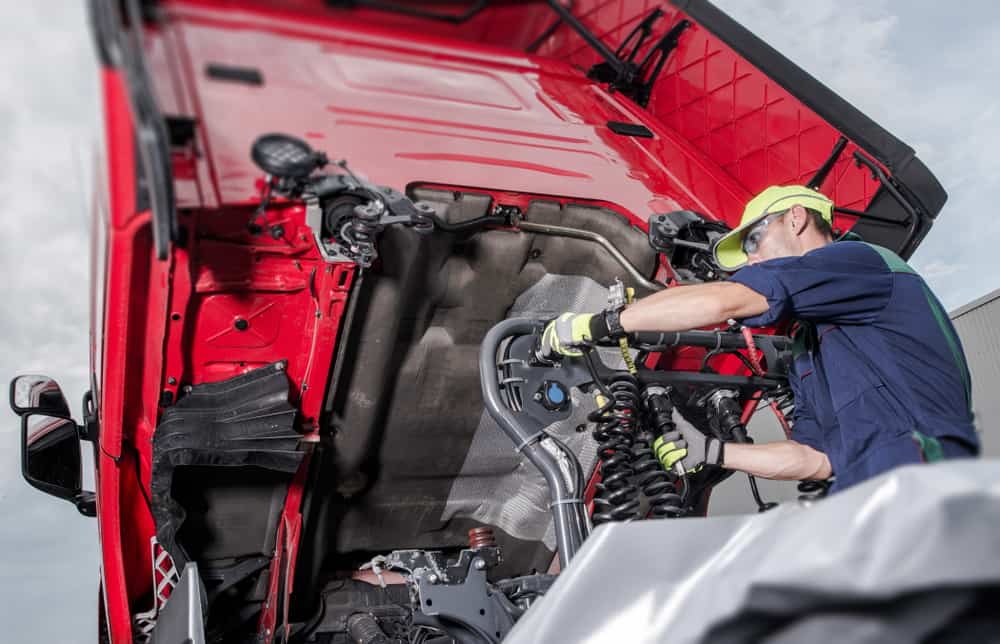
Certifications That Actually Mean Something for Heavy-Duty Truck Repair
Michigan is one of the few states in the country that legally requires mechanics to be certified. The Motor Vehicle Service and Repair Act mandates certification through the Michigan Secretary of State, and the categories for heavy trucks cover engine repair, drivetrains, brakes, suspension and steering, electrical systems, and HVAC. A mechanic working on your semi in Michigan without the appropriate certification isn’t just underqualified — they’re operating outside the law.
ASE certification is the national benchmark. The highest designation for heavy-duty truck work is ASE Certified Master Heavy-Duty Truck Mechanic, which requires passing exams across every major system category. It’s not easy to earn and it’s not automatic — it requires demonstrated competency across the full scope of heavy truck repair.
Beyond certifications, look for mechanics who have specific experience with your truck’s make and model. A mechanic who regularly works on Freightliner, Peterbilt, Kenworth, Volvo, and International trucks knows the quirks of those platforms — the common failure points, the diagnostic shortcuts that don’t work, the parts that wear faster than the service interval suggests. That familiarity matters when you’re on the side of I-275 and need someone who’s seen this exact problem before.
We’re ASE Certified Master Mechanics, and we’ve been working on heavy trucks in Wayne County for over 40 years. Freightliner, Peterbilt, Kenworth, Volvo, International, Western Star, Mack — we know these trucks. When we show up, we’re not learning on your dime.
Mobile Repair vs. Towing to a Shop — Which Actually Makes More Sense?
Most drivers assume that a serious breakdown means a tow. That’s not always true, and the assumption can cost you significantly more than the repair itself.
A qualified mobile mechanic with the right equipment can handle roughly 80% of common semi truck breakdowns on-site. That includes engine diagnostics, brake repairs, electrical troubleshooting, tire changes, fuel delivery, jump starts, and more. Our mobile units carry compressors, welding equipment, and diagnostic computers specifically because we’re built to fix trucks where they stop — not just stabilize them until a tow truck arrives.
The financial case for mobile repair is straightforward. A tow for a heavy-duty truck in the Wayne County area adds a significant cost before you’ve even looked at the repair. Then there’s the wait for the tow truck, the transport time, the shop queue, and the time to get back to your truck once it’s done. For a repairable breakdown, that sequence can easily turn a two-hour problem into a full-day delay.
One thing we hear consistently from drivers who’ve used us is that the estimate matched the final price. No surprise charges added after the work was done. We also don’t charge more for nights, weekends, or holidays — our rates are the same at 2am on a Sunday as they are at noon on a Wednesday. For owner-operators running time-sensitive loads through Wayne County, that consistency matters.
We typically arrive within 30 to 60 minutes of your call, and in many cases faster. One recent job was wrapped up in under 30 minutes from arrival. When downtime is costing you money by the hour, that response time isn’t a detail — it’s the whole point.
Finding Reliable Semi Truck Repair in Wayne County Before You Need It
Wayne County is one of the busiest freight corridors in the Midwest. Between the Ambassador Bridge, Detroit Metropolitan Airport, and the I-94 and I-75 corridors running through the heart of the region, there’s no shortage of trucks on the road — and no shortage of breakdowns that can’t wait until Monday morning.
The drivers who handle breakdowns best are the ones who already know who to call. They’re not searching from the shoulder of the road, hoping the first result is legitimate. They’ve done this homework already.
If you operate in Wayne County and want a mobile semi truck repair team that’s certified, experienced, and actually available when something goes wrong, J&J Truck & Trailer Repair is ready. Save the number now: 313-999-3088. We’re here around the clock, every day of the year, and we’ll come to you.