Most blowouts don’t surprise the tire. They surprise the driver. The tire usually knew something was wrong for miles — maybe weeks — before it finally let go on I-94 or I-75 with a full load behind you. If you’re searching for a truck tire near you right now in Wayne County, you’re either already dealing with a problem or you’ve noticed something that doesn’t feel quite right. Either way, you’re in the right place. This post covers what to watch for, why Wayne County conditions make tire wear harder on your equipment than most places in Michigan, and what actually separates a qualified provider from one who wastes your time.
How Summer Heat Destroys Commercial Truck Tires Faster Than You Think
There’s a number most drivers have never heard: 195°F. That’s the internal tire temperature at which a commercial truck tire becomes unsafe to operate. At 250°F, the structural integrity of the tire begins to fail. You don’t need a thermometer to get there — you just need a hot July afternoon on Michigan asphalt, a tire that’s a few PSI low, and a stretch of highway.
Wayne County sits in one of the most demanding operating environments for commercial tires in the Midwest. Detroit’s summers regularly push ambient temperatures into the upper 80s and 90s, and highway asphalt can exceed 150°F during peak afternoon hours. That heat transfers directly into your tires, causes the air inside to expand, and accelerates the internal wear that leads to belt separation and blowout. August is historically the worst month for commercial tire failures in this region — and mid-July is exactly when the risk starts climbing.

Wayne County Roads Add a Layer of Risk Most Markets Don't Have
Michigan’s roads are among the most pothole-damaged in the country. That’s not an opinion — it’s a structural reality driven by the state’s freeze-thaw cycle, where repeated temperature swings between deep winter lows and summer highs crack and heave road surfaces year after year. Wayne County’s industrial corridors, urban surface streets, and highway on-ramps take some of the worst of it.
Every pothole impact is a strike against your tire’s sidewall. A single hit might not cause a visible problem. But over thousands of miles of Wayne County roads — I-94 heading toward the airport, I-75 carrying Ambassador Bridge freight through Detroit, I-96 moving cargo toward Lansing — those impacts accumulate. What starts as a minor internal bruise can develop into a sidewall bulge that’s invisible until you’re crouching next to the tire with a flashlight. By then, you’re already past the point of a simple repair.
The other thing Wayne County’s road conditions do is mask slow leaks. A tire that loses a pound or two of pressure per week on a smoother highway is easier to catch early. On roads that shake and vibrate the whole rig, drivers often attribute the handling change to the road itself — not to a tire that’s quietly losing pressure and building dangerous heat with every mile.
Wayne County leads Michigan with 2,541 semi-truck accidents per year. That’s not just a statistic about bad drivers — it reflects the volume of commercial vehicles, the condition of the roads, and the cumulative stress those conditions place on equipment. Tires are one of the first places that stress shows up.
The Warning Signs Commercial Drivers Most Commonly Miss
The most dangerous tire warning sign is the one you explain away. A slight pull to one side becomes “the road is crowned.” A low vibration at highway speed becomes “it’s just the load shifting.” A slow pressure drop becomes “I’ll check it at the next stop.” These explanations aren’t always wrong — but when they’re wrong, the consequences are severe.
The warning signs worth taking seriously include a sidewall bulge or bubble, which indicates internal belt separation and means the tire cannot be safely repaired under any circumstances. Tread wear that’s uneven across the face of the tire — heavier on one side or in the center — points to inflation or alignment issues that are accelerating the tire’s deterioration. A persistent vibration or thumping at highway speed, especially one that changes with speed, often signals internal damage that isn’t visible from the outside. Any tire that’s losing pressure consistently, even slowly, is telling you something has compromised the seal.
On steer tires, federal FMCSA regulations require a minimum tread depth of 4/32 of an inch. On drive and trailer tires, the minimum drops to 2/32. Operating below those thresholds isn’t just a safety risk — it’s a federal violation that can result in an Out-of-Service order during a DOT inspection. For owner-operators and fleet managers running freight through Wayne County, that means a lost day of revenue on top of the repair cost.
One thing that often gets overlooked: tires damaged by winter potholes don’t always show their failures until summer. The cold keeps the rubber stiffer and can mask a developing sidewall crack or internal separation. When temperatures rise in June and July and that tire starts flexing under load in the heat, the damage that was dormant all spring becomes a blowout waiting for a trigger.
Truck Tire Repair Near Me: What to Actually Look for in a Provider
When you’re stranded on the shoulder of I-75 with a blown steer tire and a delivery window closing, you’re not in a position to comparison shop. That’s exactly why it matters to know what a qualified provider looks like before you need one — not after.
The most common complaint in the commercial roadside assistance space isn’t the blowout itself. It’s calling for help, waiting an hour, and having a technician show up without the right tire size, the right tools, or the capability to complete the job on the road. That’s a second wait on top of the first, and it costs more than time.
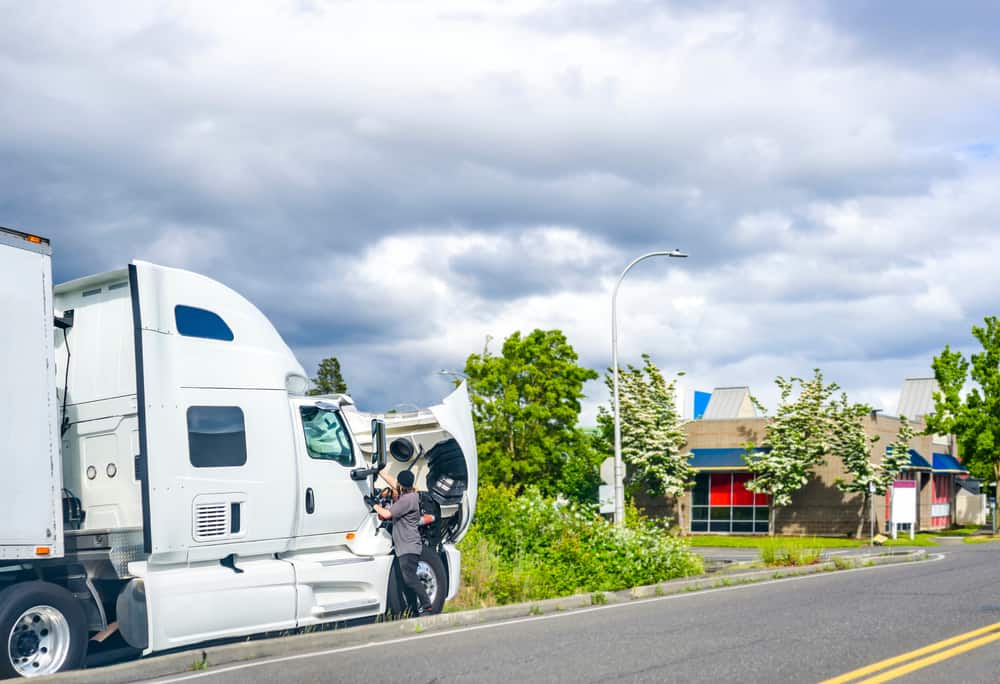
Commercial Truck Tire Repair: What the Job Actually Requires
Not every tire can be repaired. Under FMCSA regulations, commercial truck tire repairs are only permitted under specific conditions: the damage must be in the tread area, not the sidewall, and repair patches cannot overlap. Steer tires have additional restrictions. A technician who doesn’t know these rules — or who patches a sidewall because it’s faster — can create a compliance liability for the fleet operator that far exceeds the cost of a new tire.
This is where credentials matter in a way they often don’t in other service categories. Our lead mechanic, Dr. Phillip Marin, holds three Ph.D. degrees — in Diesel Engineering, Drivetrains, and Metal Alloys. The Metal Alloys background is directly relevant to tire and rim integrity, heat-related material failure, and the structural behavior of commercial tires under load. That’s not a credential any competitor in the Detroit market can match, and it changes the quality of the decision being made when a technician is standing next to your rig deciding whether to repair or replace.
Beyond the technical knowledge, the repair vs. replace decision also depends on having the right parts immediately available. We stock tires, rims, and the components needed for most common commercial tire jobs, with parts on hand the vast majority of the time. When we arrive, the goal is to complete the repair on the road — not to diagnose the problem and schedule a follow-up.
One more thing worth knowing: our rates don’t change based on when you call. A Sunday night blowout on I-96 costs the same as a Tuesday afternoon call. No surge pricing, no holiday premiums. That’s not the industry norm, and it matters when you’re already dealing with an unplanned expense.
Finding a Big Truck Tire Shop That Actually Serves Wayne County, MI
There’s a difference between a provider who lists Wayne County as a service area and one who actually knows it. Wayne County spans Detroit and more than 40 surrounding municipalities — from Romulus near the airport to Wyandotte along the river, from Dearborn’s industrial corridors to the distribution centers lining I-275 in the western part of the county. The roads, the access points, the industrial zones — they’re not interchangeable, and a technician who navigates them regularly gets to a stranded driver faster than one who’s working from a GPS and a general coverage map.
We’ve been operating in Detroit and Wayne County since the 1980s. That’s over 40 years of dispatching to highway shoulders, loading docks, distribution centers, and industrial access roads across this county. When you call J&J Truck & Trailer Repair, you reach a person — not an automated menu, not a hold queue. A human dispatcher who can confirm parts availability, give you a realistic ETA, and get a technician moving.
We handle both heavy-duty vehicles over 10,000 lbs — semi-trucks, trailers, flatbeds, tankers — and light-duty vehicles under 10,000 lbs, including RVs and motorhomes. That breadth matters for mixed fleets and for drivers who don’t fit neatly into the “commercial only” or “passenger only” categories that most providers use to sort their calls.
One customer summed up what a good service call feels like: “They were in and out in less time than it took to actually find them online. He gave us an estimate and pretty much that’s what it was.” That’s the standard we hold ourselves to on every call — fast arrival, honest estimate, job done right.
What to Do Before Your Truck Tire Becomes an Emergency
The best time to deal with a tire problem is before it becomes a blowout. If you’ve noticed a vibration that wasn’t there last week, a tire that keeps losing pressure, or a sidewall that doesn’t look quite right, those are signals worth acting on now — not after the next run.
Wayne County’s roads, summer heat, and commercial traffic volume create a combination that accelerates tire wear faster than most environments. Knowing the warning signs, understanding the FMCSA tread depth minimums, and having a qualified provider’s number ready before you need it are the three things that separate a minor inconvenience from a day-ending breakdown.
If you’re dealing with a tire issue right now — or you want to know what you’re actually looking at before you make a decision — call J&J Truck & Trailer Repair at 313-999-3088. We’re available 24/7, we answer directly, and we’ll tell you straight what the tire needs.