You’re on the side of I-75 somewhere between Detroit and the county line. Your truck isn’t moving. Your dispatcher is already calling. And you’re about to dial a roadside service number with no real idea who’s going to answer, when they’ll show up, or whether they can actually fix the problem.
That uncertainty is the worst part. Not the breakdown itself — the not knowing.
This page is about what a diesel mechanic roadside service actually does when they get to you. The real process, the honest limitations, and the things worth asking before you call anyone. If you’re in Wayne County, MI and you want to know what to expect, you’re in the right place.
What Does a Diesel Mechanic Roadside Service Actually Include?
The short answer is: a lot more than most drivers expect. A real mobile diesel mechanic isn’t just a tow truck with a wrench in the back. When the right service shows up, we arrive with diagnostic tools, parts for the most common failure types, and the training to figure out what’s wrong before we start pulling things apart.
The call itself is step one. A qualified service will ask you what’s happening — not just your location, but symptoms. Is it a no-start? A warning light? A blown tire? Air pressure dropping? That information determines what the technician loads up and what they’re prepared to handle when they arrive.
What follows on scene is a structured process, not guesswork. The difference between a provider who runs that process and one who doesn’t is the difference between rolling again in 30 minutes and waiting for a second truck.
What Happens From the Moment the Mechanic Arrives at Your Truck?
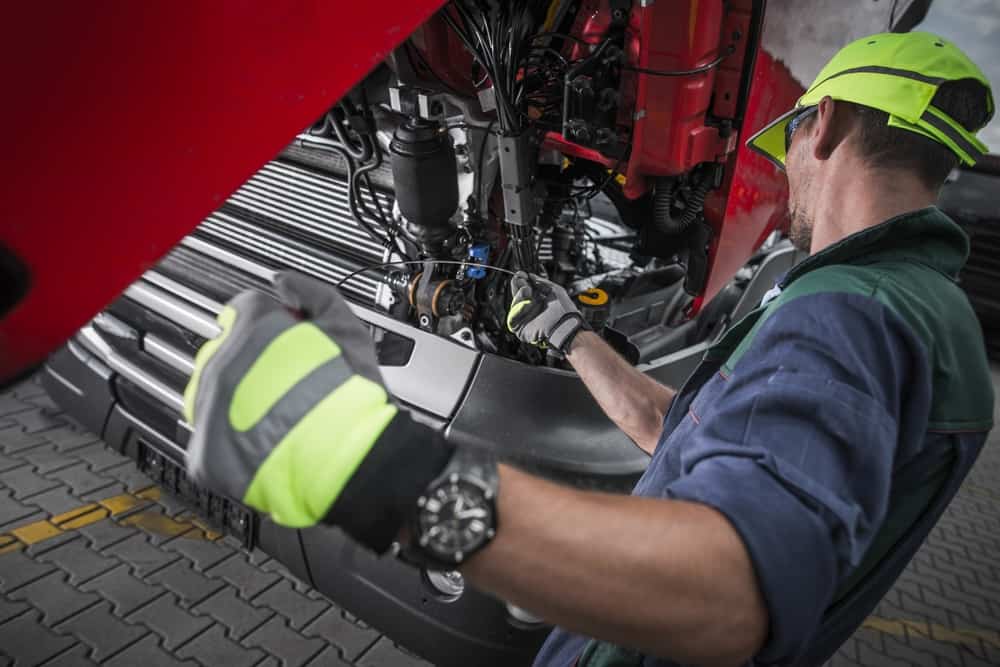
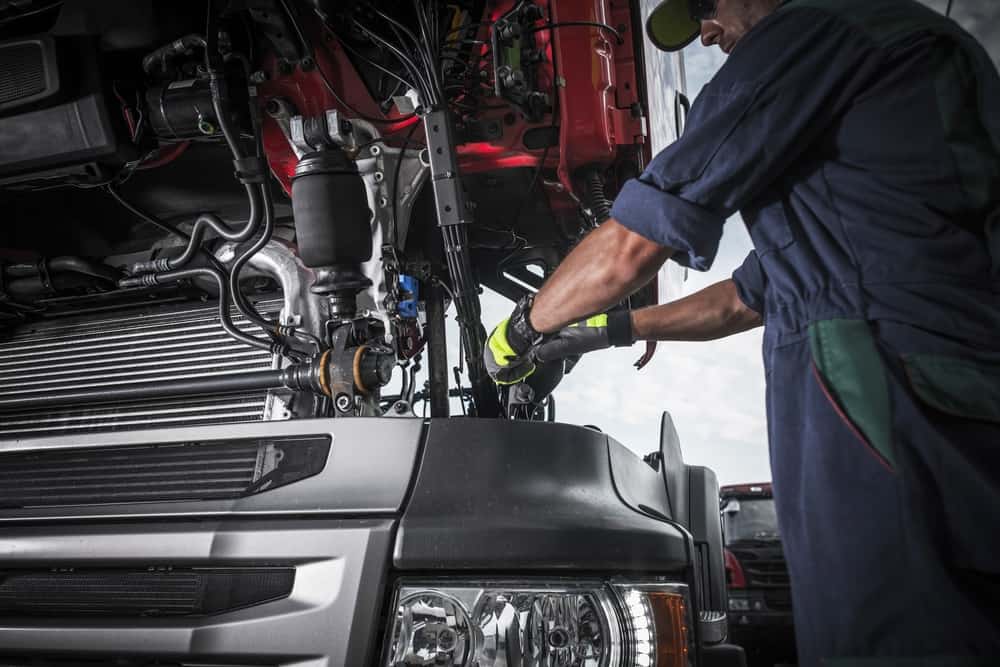
The first thing a good mobile mechanic does when they pull up is assess — visually and electronically. We’re looking at the truck before we even open a toolbox. Tire condition, visible fluid leaks, smoke, warning lights still active on the dash. That initial read tells an experienced technician a lot before any diagnostic tool comes out.
From there, most modern diesel trucks get connected to a fault code reader. This is where credentials actually matter. A Freightliner with a DEF system fault, a Kenworth throwing an aftertreatment code, a Volvo with an electrical gremlin — these aren’t problems you can eyeball. The technician needs to know what the code means, what it’s connected to, and whether it’s a root cause or a symptom of something else. Misreading that step costs you time and money.
Once the diagnosis is confirmed, the repair happens on scene if the parts and tools are on the truck. For the most common breakdown types — air line failures, brake chambers, blown tires, battery failures, hose replacements, fuel delivery issues, electrical faults — a properly stocked service truck can handle the job trackside without a tow. That matters enormously in Wayne County, MI, where I-94 through Romulus and Taylor carries over 14,000 trucks a day and every hour of downtime has a cost attached to it.
What doesn’t get talked about enough is estimate integrity. Before work begins, a real provider gives you a number and sticks to it. That’s not a given in this industry — it’s something worth asking about directly. When customers tell us the estimate matched the final invoice, that’s not an accident. It’s how we operate.
The job is done when the truck is road-ready, not when the mechanic decides they’ve done enough. A proper sign-off includes confirming the repair held, the fault code is cleared, and the vehicle is safe to operate. Anything short of that isn’t a completed job — it’s a temporary patch.
What Repairs Can Actually Be Done on the Side of the Road?
This is the question most drivers don’t think to ask until they’re already stranded — and the answer is broader than most people assume. A well-equipped mobile diesel mechanic can handle a significant range of repairs without ever towing the vehicle to a shop.
Tire blowouts are among the most common. Cab and trailer positions, including drive axle tires, can be changed or repaired on scene. Jump-starts and battery replacements happen trackside all the time — including full battery and alternator swaps when the charging system has failed. Fuel delivery is straightforward when a truck has run dry or when fuel contamination is the issue. Lockouts, while frustrating, are resolved quickly.
On the mechanical side, air line repairs, brake chamber replacements, glad hand issues, and suspension components are all within scope for a properly stocked service truck. Cooling system hoses, belts, and basic electrical troubleshooting — loose grounds, failed sensors, blown fuses — are standard on-scene work. Reefer units, which run on their own systems and can fail independently of the tractor, are also serviceable roadside when the technician knows the equipment. We service Carrier and Thermo King units specifically, which covers the majority of refrigerated trailers operating through Wayne County, MI.
What can’t always be done roadside? Frame damage, major engine internal failures, transmission rebuilds, and anything requiring a lift or a controlled shop environment. A straight-talking mechanic will tell you that on the phone before they even drive out. If a job requires a shop, the honest move is to say so — and arrange the tow rather than waste your time with a partial fix.
The reason this matters so much in Wayne County, MI is the freight profile. Trucks running through here aren’t just hauling general freight. They’re moving automotive parts on just-in-time schedules for plants in Dearborn and across the region, perishable loads through DTW in Romulus, and cross-border shipments through the Ambassador Bridge — the busiest commercial crossing in North America. A breakdown on I-75 or I-94 in this corridor isn’t a minor inconvenience. It’s a supply chain event. The faster a qualified mechanic can resolve it on scene, the less damage it does.
Best Roadside Assistance for Semi Trucks: What Actually Separates Good From Bad
The commercial roadside market has a real problem: a lot of services that market themselves as “roadside assistance for semi trucks” are actually referral networks. They take your call, route it to a third party, add a markup, and have no control over who shows up or when. You find this out when no one arrives.
The way to tell the difference is straightforward. Ask who is dispatching. Ask for a specific ETA. Ask what the technician carries on the truck. A real provider answers all three without hesitation. A broker gives you vague reassurances and a callback window.

How Do You Know If a Roadside Mechanic Can Actually Handle a Semi?
This is a legitimate concern, and it’s more common than the industry likes to admit. Many roadside services that advertise “truck repair” are built around light-duty vehicles — passenger cars, pickup trucks, maybe a box van. They added “semi trucks” to their marketing without adding the equipment, parts inventory, or technical training to back it up.
The clearest signal is specificity. A real heavy-duty mobile mechanic can tell you exactly which truck brands they service. Not “all trucks” — specific makes. Freightliner, Peterbilt, Kenworth, Volvo, International, Western Star, Mack, Hino. Same with trailers: Utility, Great Dane, Hyundai, Manac. If a service can’t name the equipment they work on, that’s a gap worth noting.
Credentials matter here more than most drivers realize. The diesel technician field has a certification structure through ASE — the T-series, covering diesel engines, drivetrains, brakes, electrical systems, HVAC, and preventive maintenance. A Master Truck Technician designation requires passing the full series. These aren’t just pieces of paper — they reflect whether the person working on your truck understands modern emissions systems, fault code logic, and the mechanical architecture of Class 8 vehicles.
We lead with this because Dr. Phillip Marin, who heads our operation, holds three Ph.D. degrees — in Diesel Engineering, Drivetrains, and Metal Alloys. That’s not a credential you find at most roadside services. It means when a complex diagnostic problem comes up — the kind other shops have already failed to solve — there’s a level of technical depth available that goes well beyond what most mobile mechanics can offer. Multiple customers have specifically noted that we resolved problems other shops couldn’t. That’s what happens when the person doing the work has spent decades studying the systems at the highest level.
Is 24 Hour Commercial Roadside Assistance in Wayne County, MI Actually Available Around the Clock?
“24/7 availability” is one of the most overused and least honest phrases in the roadside assistance business. Almost every service says it. What it means in practice varies wildly.
Some services are genuinely available around the clock — a real person answers, a qualified mechanic dispatches, and help is on the way regardless of whether it’s 2 PM on a Tuesday or 6:30 AM on a Sunday in January. Others use “24/7” to mean a call center answers and logs your information until the morning shift starts. That distinction is enormous when you’re sitting on the shoulder of I-96 in February.
Wayne County, MI winters are not forgiving. Temperatures regularly drop below 20°F, and diesel fuel begins to gel around 15°F without anti-gel treatment. Battery failures spike in cold weather. Air brake systems trap moisture that freezes. The breakdowns that happen in those conditions are the same ones that require a provider who actually dispatches in those conditions — not one who routes your call to a queue.
We’ve driven 40 miles to a breakdown at 6:30 in the morning in 7-degree weather on a Sunday. That’s documented. It’s not the kind of thing that happens by accident — it’s the result of running a family-operated business where Dr. Phil and his son Jason are personally involved in every dispatch. When you call 313-999-3088, you’re not reaching a national call center. You’re reaching the people who are going to show up.
That’s the version of 24/7 that actually matters when you’re stranded on I-275 in the middle of the night with a load that needs to be somewhere by morning. The question isn’t whether a service claims to be available — it’s whether they’ll actually come.
What to Do When Your Truck Breaks Down in Wayne County, MI
The short version: call someone who can actually fix it, not just find you someone else who might.
A diesel mechanic roadside service is only as good as the person who shows up — their training, their equipment, and whether they’re honest with you about what they can and can’t do on scene. In Wayne County, MI, where freight moves around the clock on some of the busiest truck corridors in the Midwest, that question has real consequences. A 30-minute on-scene repair and a four-hour wait for the wrong provider are both “roadside assistance.” They are not the same thing.
If you want to know what to expect before you’re in that situation — or if you’re already there — J&J Truck & Trailer Repair is available right now. Call 313-999-3088.