
You paid for a national commercial roadside plan. Your truck breaks down on I-75 near the Ambassador Bridge at midnight. You call the number on your card. The dispatcher starts searching their database for an enrolled heavy-duty provider. Thirty minutes later, they call back: the nearest one is 94 miles away.
That’s not a horror story. That’s a documented failure mode — and it happens more often than the plan brochures suggest.
This post is for fleet managers and owner-operators in Wayne County, MI who want to understand what they’re actually buying before something goes wrong, not after.
Commercial Truck Roadside Assistance: What National Plans Actually Deliver
The phrase “national commercial roadside assistance” covers at least four very different products, and buyers routinely conflate them. Some plans are directories — they publish a searchable database of repair shops, but they don’t dispatch anyone. You find the shop, you make the call, you coordinate the repair yourself. Others are reimbursement programs: you pay out of pocket at the time of the breakdown, then submit a claim and wait for a check.
A third model is the call-center dispatch network, where a live operator searches an enrolled database and contacts whoever is available — which is only as good as who’s enrolled, where they are, and whether they answer at midnight. None of these is the same as calling a local provider who answers the phone, knows your highway, and puts a qualified technician in a truck headed your way.
What Happens When a National Plan Can't Find a Provider in Your Area
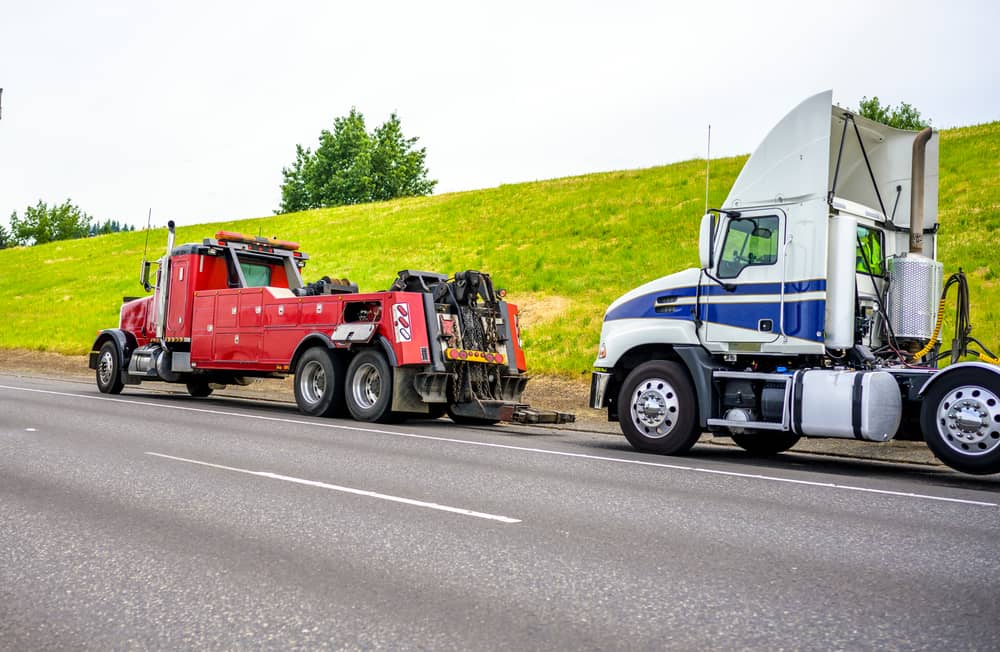
The coverage gap isn’t theoretical. One documented case involved a fleet manager whose truck broke down on a rural corridor at 11 PM. The national plan’s nearest enrolled heavy-duty provider was 94 miles away. The after-hours surcharge added 40% to the invoice. The truck sat for six hours. The plan “covered the state” — it just didn’t cover that corridor at that hour.
Wayne County, MI isn’t rural, but the problem is the same in structure. A national network that lists 75,000 providers sounds comprehensive until you’re broken down on I-94 near Dearborn and the nearest enrolled heavy-duty technician is backed up with three other calls. The network covers a map. It doesn’t guarantee a response time on your specific stretch of highway at 2 AM.
This is the part no one explains clearly when you’re shopping for a plan. The enrollment database tells you who’s in the network. It doesn’t tell you who’s available, how far away they are, or whether they have the right equipment for a Class 8 truck. A general auto mechanic showing up for a semi-truck breakdown isn’t just unhelpful — it adds time, confusion, and often a second call to find someone who can actually do the work.
There’s also the cost side. Heavy-duty towing runs $3.50 to $7.50 or more per mile. When the nearest available provider is far away, that mileage adds up before the repair even starts. If your plan charges after-hours surcharges — which many national plans do, commonly at 40% above standard rates — a breakdown at midnight on a holiday can produce an invoice that looks nothing like what you expected.
Commercial vehicle downtime costs exceed $340 per hour according to the National Association of Fleet Administrators. A six-hour wait isn’t just frustrating. It’s a significant financial event, especially for Wayne County, MI operators whose trucks are often carrying time-sensitive automotive supply chain freight where delays ripple downstream.
24-Hour Commercial Roadside Assistance: Genuine vs. On Paper
Every provider in this space claims 24/7 availability. It’s worth asking what that actually means in practice.
For some national plans, “24/7” refers to the dispatch call center — someone will answer the phone at 3 AM. What happens after that depends on whether there’s an enrolled provider in your area who is also available at 3 AM. Some plans document phones shutting down at 6 PM Monday through Friday, with drivers left to figure it out on their own. The plan marketed as round-the-clock emergency coverage turned out to be business-hours coverage with a voicemail after that.
Genuine 24-hour commercial roadside assistance means a technician — not just a dispatcher — is reachable and deployable at any hour. It means the person who answers the phone can tell you when someone will arrive, not just that they’re searching. And it means the rate you’re quoted at midnight is the same rate you’d pay at noon, with no surcharge added because the clock says 2 AM.
That last point matters more than it sounds. If you’re managing a fleet in Wayne County, MI and your trucks run overnight — which many do, given the freight volume moving through Detroit’s highway network — a plan that penalizes you financially for using it at the exact moment you need it most isn’t a plan that’s working for you. It’s a plan designed around business hours, sold as emergency coverage.
The practical test for any roadside plan is simple: call the number at midnight on a Sunday and ask how long it will take for a heavy-duty technician to reach you on I-96 near Detroit. The answer to that question tells you more than any brochure.
Fleet Roadside Assistance in Wayne County, MI: Why Local Depth Beats National Reach
For a fleet operating in Wayne County, MI, the relevant coverage area is Wayne County — I-75, I-94, I-96, I-275, I-696, and the corridors connecting them. A national plan’s 50-state reach doesn’t help a driver broken down near the Ambassador Bridge approach at midnight. What helps is a provider who knows every shortcut in the county, has the right equipment on the truck, and can be there in minutes rather than hours.
Local coverage isn’t a consolation prize for fleets that can’t afford a national plan. For regional operations, it’s often the more reliable option — precisely because the provider’s entire business is built around being available and capable in a defined area, not spread thin across a national database.
What to Look For in a Commercial Roadside Provider Before You Need One
Fleet managers who pre-vet their roadside vendors before a breakdown are in a fundamentally different position than those who search for help from the shoulder of I-94 at midnight. The time to evaluate a provider is when you’re not under pressure — when you can ask real questions and get real answers.
The first thing worth asking is whether the provider dispatches directly or works through a third-party network. Direct dispatch means the person you call is the person sending the technician. Network dispatch means you’re calling a coordinator who then searches for someone available — adding a layer of delay and uncertainty that matters when every hour of downtime costs you money.
Second, ask about technician credentials. Michigan requires state certification for mechanics performing heavy-duty truck repair — not just ASE certification, but a state-issued credential from the Secretary of State’s office. The highest level, Master Heavy-Duty Truck Mechanic, requires passing all heavy-duty repair categories under Michigan’s certification framework. This isn’t a voluntary marketing badge. It’s a legal requirement, and not every provider meets it at the level you’d want for a $150,000 truck.
Third, ask about equipment. A mobile unit that carries compressors, welding equipment, and diagnostic computers can fix problems on the road that an underprepared service truck cannot. The goal of a good roadside call is to get the driver back on the road — not to generate a tow invoice because the technician didn’t have what they needed.
Finally, ask about pricing structure. Flat-rate pricing that doesn’t change based on time of day, day of week, or whether it’s a holiday gives you predictable costs. Plans with after-hours surcharges can turn a manageable repair bill into a financial surprise at the exact moment you’re least prepared for it.
Why Wayne County, MI Roads and Freight Corridors Make Local Knowledge a Real Advantage
Wayne County, MI has a specific set of conditions that a national call center simply doesn’t account for. Michigan winters regularly push temperatures below zero, causing battery failures, diesel fuel gelling, and air line freeze-ups on trailer brake systems. These aren’t edge cases — they’re annual, predictable events for any fleet running through Detroit in January or February. A local provider who has worked these roads for decades knows what breaks, when it breaks, and how to fix it fast.
Spring brings pothole season. The freeze-thaw cycle hits Wayne County, MI roads hard every year, and the resulting tire blowouts and suspension damage create a predictable surge in roadside calls. If your fleet is running parts deliveries to automotive plants in the county — and a significant number of commercial trucks in Wayne County, MI are doing exactly that — a breakdown during peak production hours isn’t just an operational inconvenience. It can trigger supply chain delays that cost far more than the repair itself.
The Ambassador Bridge corridor adds another layer of complexity. I-75 near the Detroit-Windsor crossing is one of the highest-volume commercial trucking corridors in North America, handling roughly a quarter of all US-Canada trade by value. A breakdown near that corridor during customs hours carries implications beyond the repair cost — missed crossing windows, border delay complications, and the kind of freight disruption that gets escalating phone calls from dispatchers and plant managers.
A provider who operates in Wayne County, MI every day, covers all five of the county’s major interstates, and has over 40 years of experience working these specific roads brings something a national call center cannot replicate: actual local knowledge, not just a pin on a map.
Choosing the Right Commercial Roadside Assistance for Wayne County, MI Fleets
The difference between a national plan and a local provider isn’t just about response time. It’s about what actually happens when the phone gets answered — whether a technician is coming or a database search is starting, whether the rate holds at midnight or a surcharge kicks in, whether the person who shows up can fix the truck on the road or just tow it somewhere.
For fleet managers and owner-operators running commercial vehicles through Wayne County, MI, the right time to answer those questions is before a breakdown, not during one.
J&J Truck & Trailer Repair is a family-owned, Detroit-based operation with over 40 years of experience in commercial roadside assistance and heavy-duty truck repair. If you want to know what genuine local coverage looks like for your fleet, call us directly at 313-999-3088 — any hour, any day.