Most people call for a tow and take whatever shows up. That’s understandable — when you’re broken down on the shoulder of I-75 in January, you’re not exactly in a position to be picky. But the type of tow truck that responds to your call isn’t a minor detail. It can determine whether your vehicle arrives at the shop in the same condition it left the roadside, or whether you’re now dealing with two problems instead of one.
This guide walks you through exactly what separates a flatbed tow truck from hook-and-chain and wheel-lift alternatives — and which method is right for your specific vehicle. If you’re stranded anywhere in Wayne County, MI, knowing this difference could save you thousands in unexpected repairs.
How a Flatbed Tow Truck Works
A flatbed tow truck has a long, flat platform mounted on the back that tilts down hydraulically so a vehicle can be driven or winched onto it. Once loaded, all four wheels are completely off the ground for the entire tow. The vehicle is secured using straps and T-hooks — no chains touching the body, no contact with the road surface.
That last part is what makes flatbed towing the industry standard for most situations. When all four wheels are off the ground, there’s no drivetrain movement, no friction, and no stress on the vehicle’s mechanical systems during transport. It’s as close to carrying your car as you can get without actually lifting it by hand.
Flatbed tow trucks now represent 55% of the total U.S. tow truck fleet — and that shift didn’t happen by accident.

How Hook-and-Chain Towing Works — and Where It Goes Wrong
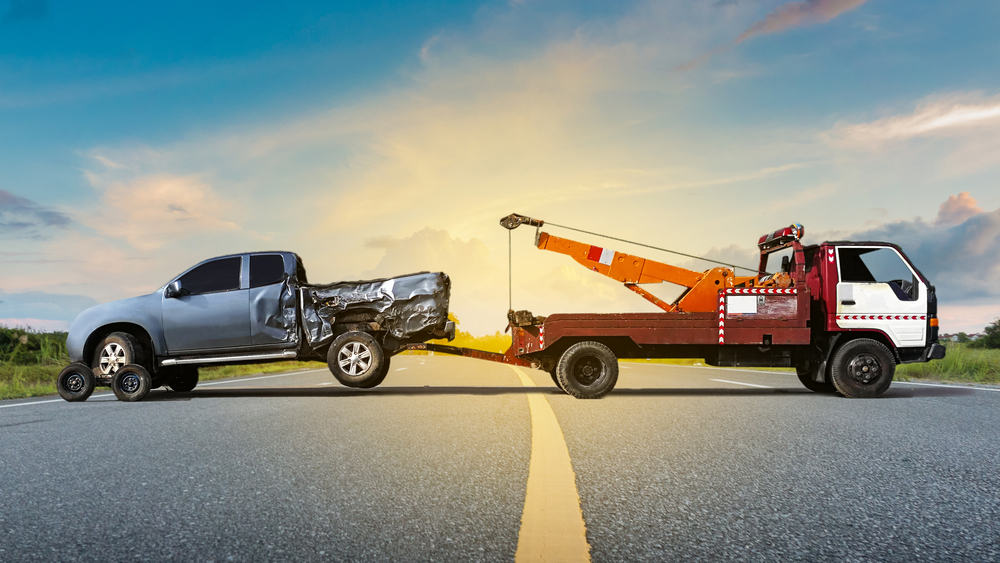
Hook-and-chain towing — sometimes called sling towing — is an older method where chains or a metal hook attach to the vehicle’s frame or axle, and either the front or rear end is lifted off the ground using a boom and winch. The other two wheels stay on the road and drag along for the entire tow.
For a junk vehicle headed to a scrapyard, that’s fine. For a working car, it’s a different story.
The most common and expensive type of damage from improper towing is transmission failure. In an automatic vehicle, the transmission depends on a pump powered by the running engine to circulate lubrication fluid. When the engine is off and the drive wheels are still rolling on the ground, internal components keep spinning — without that lubrication. The heat builds fast. The wear compounds. The result can be shifting problems, internal damage, or complete transmission failure. Repair costs for that kind of damage can run anywhere from $1,500 to over $4,000.
It doesn’t stop at the transmission. Modern vehicles have plastic aerodynamic bumpers that aren’t designed to handle the pressure of a hook or chain. Hook-and-chain contact can crack them, pull them loose, or scratch them badly enough that the cosmetic repair alone becomes a real expense. On vehicles with low ground clearance, the dragging end of the car can also scrape and damage the undercarriage.
There are situations where hook-and-chain towing is still a legitimate choice — salvage and junk vehicle removal, certain off-road recoveries, and specific heavy industrial applications. But for any vehicle you plan to drive again, it’s the wrong call.
Wheel-lift towing is worth mentioning here because it’s often confused with flatbed towing. A wheel-lift truck uses a hydraulic yoke to lift either the front or rear axle, which is an improvement over hook-and-chain in some ways — there’s no direct contact with the frame or body. But two wheels are still on the ground, still rolling, still spinning drivetrain components without engine lubrication. For AWD and 4WD vehicles especially, that’s still a problem.
Which Vehicles Actually Require a Flatbed Tow Truck
The short answer: more vehicles than most drivers realize.
AWD and 4WD vehicles are the clearest case. When all four wheels are mechanically connected — which is the entire point of all-wheel drive — towing with two wheels on the ground forces the center differential and drivetrain components to work against each other. The damage to the differential alone can be catastrophic, and it’s not always immediately obvious. Some drivers get home, park the car, and don’t notice the problem until the next time they accelerate on a slick surface.
Luxury vehicles and low-clearance cars need flatbed towing for a different reason. Their ground clearance is too tight for the dragging end of a hook-and-chain tow to clear road imperfections safely. Wayne County roads — particularly in Detroit, Dearborn, and through the Downriver communities — are notoriously rough. The freeze-thaw cycle that hits this region every winter tears up pavement in ways that make even a short tow a risk for a low-slung vehicle dragging on the road surface.
Classic and collector cars need flatbed towing for obvious reasons. No metal contact, no dragging, no road surface friction. If a car has any kind of value beyond scrap, a flatbed is the only responsible choice.
Motorcycles are also flatbed-only. There’s no way to safely wheel-lift or hook-and-chain a motorcycle without risking the frame, the fairings, or the bike’s balance entirely.
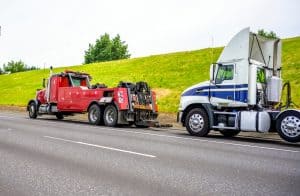
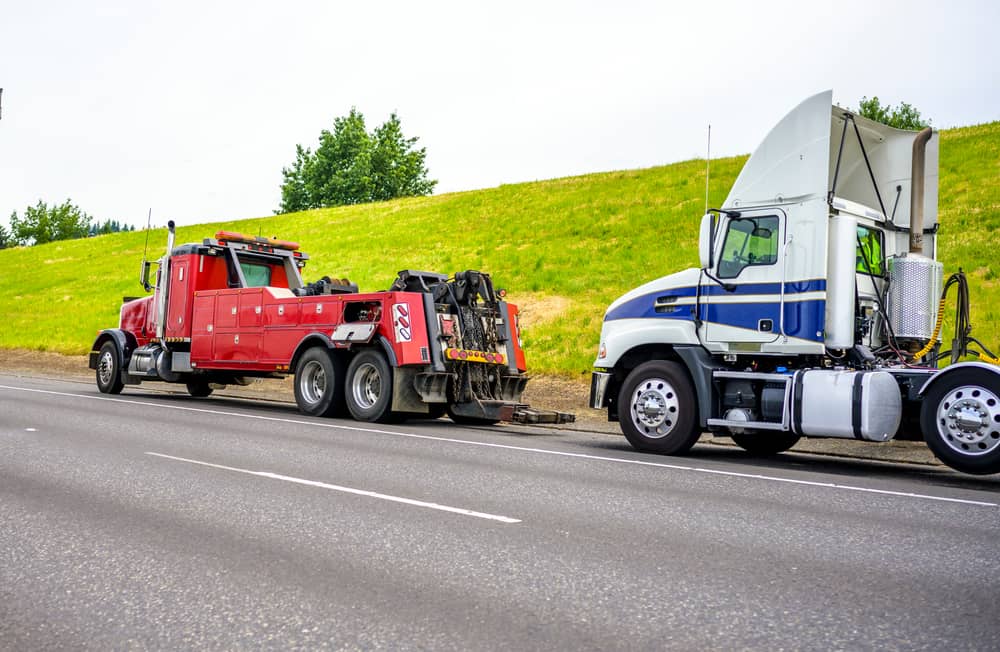
And then there’s the commercial side — semis, box trucks, dump trucks, and construction equipment. These vehicles operate in a completely different weight class, and the towing method question becomes more complex. Most light-duty towing operators in Wayne County simply don’t have the equipment to handle a vehicle over 10,000 pounds. That’s not a criticism — it’s just a capability gap that matters when your rig is sitting on the shoulder of I-94 and you need someone who can actually move it.
What Wayne County Drivers Should Know Before Calling for a Tow
Wayne County is one of the busiest freight and commuter corridors in the Midwest. I-94, I-75, I-96, I-275, and M-10 see constant traffic — commercial trucks crossing through on their way to and from the Ambassador Bridge, commuters moving between Detroit and the surrounding communities, and everything in between. Breakdowns happen here every day, and the towing response that follows isn’t always the right one for the vehicle involved.
Knowing what to ask for before a truck shows up puts you in a much stronger position. And knowing you have the right to refuse a towing method that could damage your vehicle is something most drivers in this area have never been told.
Can You Refuse a Hook-and-Chain Tow and Request a Flatbed Instead?
Yes. And more Wayne County drivers should know this.
If a tow truck operator arrives with hook-and-chain equipment and your vehicle is a working car — especially an AWD, a luxury vehicle, or anything with a drivetrain you’d like to keep intact — you are within your rights to refuse that method and request a flatbed tow truck instead. You don’t have to accept whatever pulls up.
This matters most in situations where your insurance company’s roadside assistance program is dispatching the tow. Those programs typically send the cheapest available operator, not necessarily the most appropriate one for your vehicle type. The driver who shows up may be perfectly capable — but if they’re arriving with a hook-and-chain truck and you’re driving a 4WD pickup or an AWD crossover, that’s a mismatch worth speaking up about.
The conversation doesn’t have to be confrontational. A simple “I need a flatbed for this vehicle” is a reasonable request. Any professional operator will understand it. If they push back, that’s useful information about who you’re dealing with.
Michigan’s towing regulations, enforced by the Michigan State Police Commercial Vehicle Enforcement Division, require all operating towing companies to carry active liability and worker’s compensation insurance. You can verify a company’s operating authority through the CVED’s carrier registration system. In a state that ranks 34th out of 51 in consumer protection towing practices, doing that verification ahead of time — before you’re stranded on I-75 at midnight — is genuinely worth the few minutes it takes.
Tow My Car — or Fix It on the Spot?
Here’s something most towing companies won’t tell you: sometimes the right answer isn’t a tow at all.
A dead battery on I-96. A blown tire on M-85 through the Downriver area. A fuel issue on I-275 near Romulus. These situations feel like towing calls, but they don’t have to be. If a mobile repair unit can reach you and handle the problem on-site, you’re back on the road faster and without the added complexity of coordinating a shop visit.
At J&J Truck & Trailer Repair, we run mobile units equipped with diagnostic computers, compressors, welding equipment, and common parts for both light-duty and heavy-duty vehicles. Our approach is straightforward: if we can fix it where you are, we fix it where you are. We only tow when towing is actually the right call.
That philosophy matters more than it might seem. A lot of breakdown situations get escalated to tows because the responding company doesn’t have the capability to do anything else. We do. And when a tow is necessary, we have the right equipment for your vehicle — flatbed trucks for passenger and light-duty vehicles, and heavy-duty wreckers and rotator trucks for commercial vehicles over 10,000 pounds.
Our team is led by Dr. Phillip Marin, who holds three Ph.D. degrees in Diesel Engineering, Drivetrains, and Metal Alloys. When he or one of our technicians recommends a towing method, it’s not a default — it’s a decision grounded in an understanding of what’s actually happening inside your vehicle’s drivetrain. That’s a different level of assessment than most roadside operators are equipped to offer.
We’ve been doing this as a family-owned business since the 1980s, and we serve the full Wayne County area — Detroit, Dearborn, Livonia, Westland, Taylor, Southgate, and the Downriver communities — along every major corridor including I-94, I-75, I-96, I-275, and M-10. Our rates are the same at 3 AM on a Sunday as they are at noon on a Tuesday. No surge pricing, no holiday fees. If we give you an estimate, that’s what you pay.
We’re available around the clock at 313-999-3088. Real people answer. Dispatch goes out within minutes.
Choosing the Right Tow Truck in Wayne County: The Bottom Line
The difference between a flatbed tow truck and a hook-and-chain isn’t just a technical footnote — it’s the difference between a vehicle that arrives at the shop intact and one that arrives with a new problem. For AWD vehicles, luxury cars, low-clearance vehicles, and anything with a drivetrain worth protecting, flatbed towing isn’t optional. It’s the only responsible choice.
Wayne County drivers deal with rough roads, hard winters, and one of the busiest freight corridors in the Midwest. Breakdowns here are common. Bad tows shouldn’t be.
Know what to ask for. Know you can refuse the wrong method. And if you want a team that already knows the difference — and can often skip the tow entirely — J&J Truck & Trailer Repair is a call away.