If your semi goes down on I-75 at 2 AM in January, you don’t have time to vet five towing companies. You call the first number that answers, hope they know what they’re doing, and pray the truck doesn’t end up worse than when they found it. That’s the reality for most commercial operators in Wayne County, MI — and it’s exactly why choosing the right provider before you need one matters so much. This page breaks down what heavy duty towing actually requires, what the risks look like when it goes wrong, and what to look for when you’re making that call.
What Is Heavy Duty Towing — and Why Does It Require Different Equipment?
Heavy duty towing refers to the recovery and transport of vehicles weighing over 10,000 pounds — Class 6, 7, and 8 trucks, tractor-trailers, construction equipment, and large commercial vehicles. It’s not simply a scaled-up version of towing a passenger car. The equipment, the rigging techniques, and the operator training required are fundamentally different.
A standard light-duty wrecker is physically incapable of safely recovering a loaded 18-wheeler. Attempting it risks secondary damage to the drivetrain, the frame, and the cargo — and it puts the operator and anyone nearby in danger. Only about 5% of towing providers in the U.S. are genuinely equipped for heavy duty work, which means the majority of companies that answer the phone can’t actually do the job safely.
What Equipment Does a Real Heavy Duty Tow Truck Need?
The gap between a light-duty wrecker and a true heavy duty recovery unit comes down to a few critical pieces of equipment — and understanding them helps you ask the right questions before you commit to a provider.
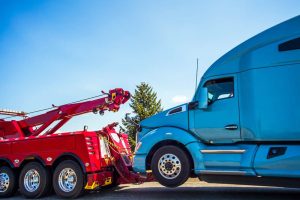
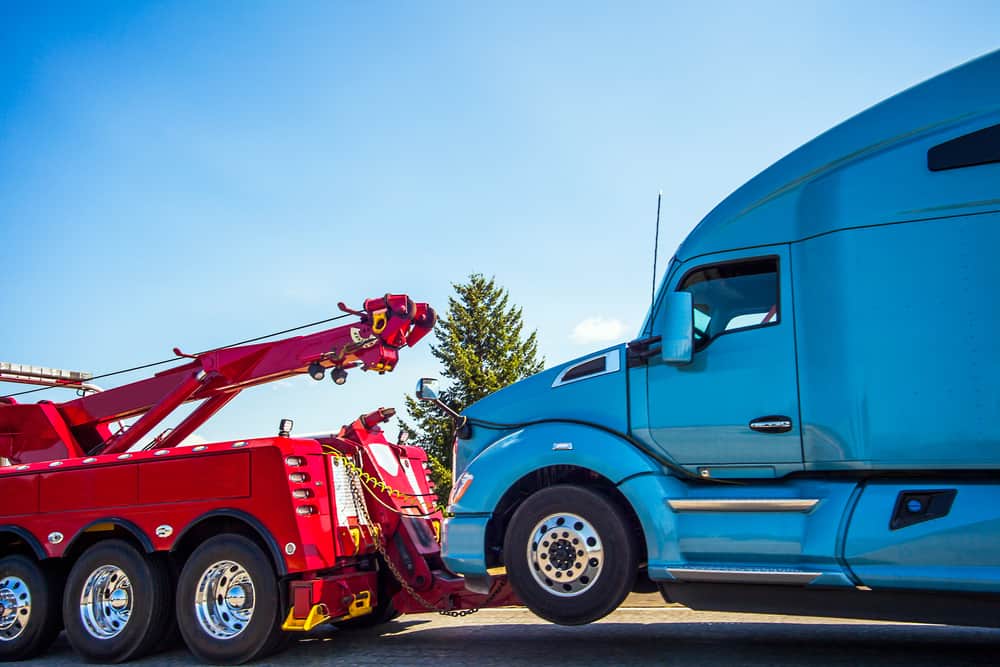
An integrated rotator is one of the most important tools in heavy duty recovery. It allows the operator to lift and swing a load through a full 360-degree arc, which is essential when a truck has jackknifed, rolled, or ended up in a position where a straight pull isn’t possible. A rotator rated for heavy work can handle loads of 70 tons or more — that’s over 140,000 pounds. Without one, certain recoveries simply can’t be done safely.
An underlift attachment is equally important for semi truck towing. It cradles the rear axle or frame of the vehicle rather than relying solely on a chain or hook, which protects the drivetrain during transport. This matters especially for tractor-trailers, where improper hookup can damage the transmission, driveshaft, or axle seals — damage that isn’t always visible until the truck is back in service.
Air supply is another piece of equipment that separates genuine heavy duty operators from everyone else. When a semi’s air brakes lock up — which happens frequently after a breakdown or accident — the only way to safely move the vehicle is to supply external air pressure to release them. A provider without an onboard air compressor either can’t move the truck at all or forces it in a way that causes brake and wheel-end damage.
Wayne County’s roads add another layer of complexity here. Michigan allows higher gross vehicle weight limits than most states, which means trucks operating on I-94, I-75, and I-96 through Detroit can be significantly heavier than the federal 80,000-pound standard. A provider equipped for standard federal weight limits may not be equipped for what’s actually running through this market.
Can a Regular Tow Truck Tow a Semi? The Risk of Calling the Wrong Provider
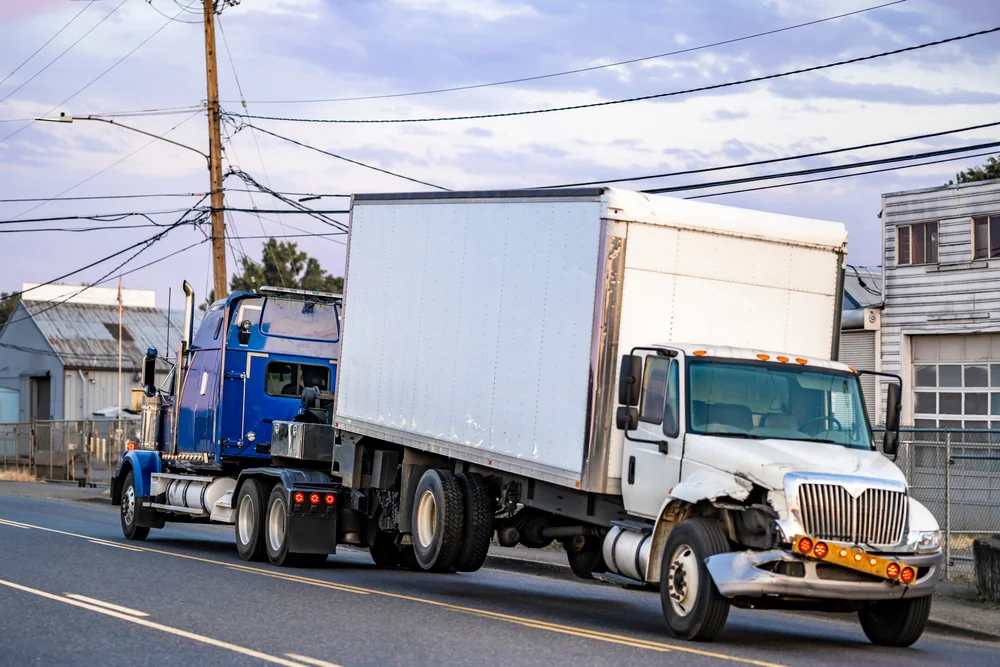
This is one of the most common and costly mistakes commercial operators make — calling a general towing company that claims to handle everything, only to have a light-duty or medium-duty wrecker show up at a scene it can’t manage.
The immediate problem is obvious: the truck doesn’t move. But the secondary problem is worse. An operator who attempts a recovery with undersized equipment can cause real damage — to the frame, the fifth wheel, the landing gear, the air lines, or the drivetrain — damage that turns a roadside repair into a shop job, and a shop job into a week of downtime.
There’s also a safety dimension that doesn’t get enough attention. A wrecker that’s undersized for the load it’s attempting to move is an unstable system. On a busy corridor like I-94 or I-275 in Wayne County, where traffic doesn’t slow down for much, that instability is a serious hazard for the operator, the driver, and everyone else on the road.
The right question to ask any provider before they roll isn’t “can you tow a semi?” — it’s “what’s your equipment rated for, and do you have air supply and an underlift on the truck?” If they can’t answer that clearly, that’s your answer.
Federal FMCSA regulations require a CDL for towing vehicles with a GVWR over 26,000 pounds. That’s a legal baseline, not a performance standard. Beyond licensing, look for operators with WreckMaster or TROCP certification — the national standard for heavy recovery recognized by the Federal Highway Administration. These aren’t just credentials on a wall. They represent real training in the specific scenarios — jackknifes, rollovers, locked brakes, cargo recovery — that define heavy duty towing.
Semi Truck Towing in Wayne County, MI — What Commercial Operators Need to Know
Wayne County, MI sits at one of the most active commercial freight intersections in the Midwest. The Ambassador Bridge connects Detroit to Windsor, Ontario — the busiest international border crossing in North America by trade volume — and the county’s highway network feeds directly into that corridor. I-94, I-75, I-96, I-275, and I-696 all carry heavy commercial traffic through the area daily, and breakdowns on these routes are a statistical certainty for any fleet operating here.
Commercial fleet vehicles average roughly 2.4 roadside breakdowns per vehicle per year. For a fleet running ten trucks through Wayne County, that’s more than twenty breakdown events annually. Having a reliable heavy duty towing provider already in your phone isn’t a precaution — it’s an operational necessity.
Semi Towing After a Blowout — Why Tire Failures Are the Leading Cause of Heavy Towing Calls
Tire failure accounts for approximately 50% of all semi truck towing calls. That number is even higher in Michigan, where the freeze-thaw cycle destroys road surfaces year after year and Wayne County, MI roads are among the most deteriorated in the state. Potholes, heaving pavement, and surface cracking put enormous stress on commercial tires — and when a tire goes at highway speed, the damage to the surrounding components can be significant.
A blowout on a loaded semi isn’t just a flat tire. Depending on which axle fails and how the driver responds, you can end up with rim damage, brake line damage, fender and mud flap damage, and in some cases frame contact. The tow itself has to account for all of that — you can’t just hook up and drag.
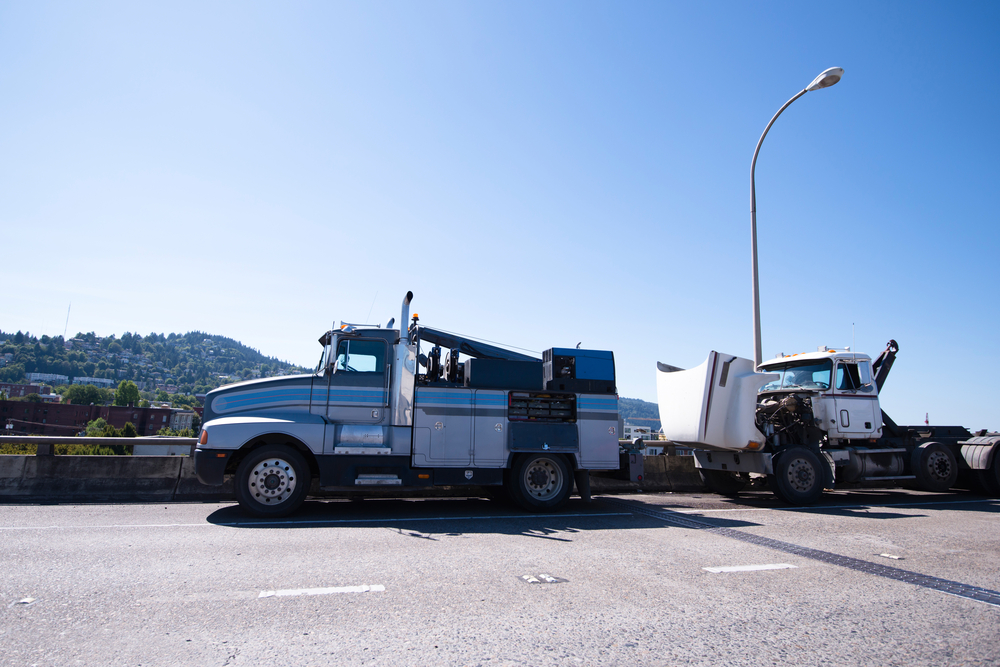
This is where mobile repair capability changes the equation entirely. When we show up, we can assess the full damage, replace the tire on-site, check the brake lines, and get the truck moving again without a tow. That saves you hours of downtime and the cost of transport to a shop. We carry the tools to handle exactly this kind of situation — compressors, diagnostic equipment, and the mechanical knowledge to tell you on the spot whether the truck can roll or needs to come in.
Michigan winters make this even more relevant. When temperatures drop below zero on I-75 and a tire goes, the driver isn’t just dealing with a mechanical problem — they’re dealing with a safety emergency. Speed of response and the ability to actually fix the problem in the field, not just haul the truck somewhere, is what gets that driver home safely.
RV Towing in Wayne County — A Heavier Job Than Most People Expect
RV towing is one of the most misunderstood categories in roadside assistance. Most people assume a motorhome or fifth-wheel is a light-duty vehicle — something any towing company can handle. The reality is that a Class A motorhome can weigh anywhere from 30,000 to 50,000 pounds or more, which puts it squarely in heavy duty territory. Calling a standard tow truck for a large motorhome is the same mistake as calling one for a semi — the equipment isn’t rated for it, and the risk of damage is real.
The stakes are also different emotionally. A commercial truck breakdown is a business problem. A motorhome breakdown — especially on a trip with family, in bad weather, or far from home — is a personal crisis. We’ve handled both, and we treat them the same way: show up with the right equipment, assess the situation honestly, and get it resolved as fast as possible.
One of our customers called us at 6:30 on a Sunday morning after their motorhome died on the road. It was seven degrees outside. We were 40 miles away — but we were the only provider in the area with 24/7 service who actually answered. We diagnosed the problem, had the parts on the truck, replaced the batteries and alternator on-site, and got them back on the road. That’s what big truck towing and RV recovery looks like when it’s done right: the right equipment, the right knowledge, and someone who actually shows up.
For Wayne County, MI residents and travelers passing through on I-94 or I-96, the question isn’t whether your RV will ever need roadside help — it’s whether the provider you call will have what it takes to handle it. Not every company that claims to do RV towing has equipment rated for a 40,000-pound motorhome. Ask before you assume.
How to Choose a Heavy Duty Towing Company in Wayne County, MI
The short version: ask about equipment ratings, air supply capability, and operator certification before you commit to anyone. A provider who can answer those questions clearly and specifically is a provider who actually does this work. One who gives you vague reassurances probably doesn’t.
Beyond the equipment, look for someone with real mechanical knowledge — not just towing capability. The ability to diagnose and repair on-site is what separates a provider who gets your truck moving from one who just moves it somewhere else and leaves the problem for someone else to solve.
We’ve been doing this in Wayne County, MI for over 40 years. Dr. Phillip Marin holds three Ph.D. degrees in Diesel Engineering, Drivetrains, and Metal Alloys — which means when we assess your truck on the side of I-75 at midnight, we’re not guessing. If you want to know more or need help right now, J&J Truck & Trailer Repair is available 24/7 at 313-999-3088. Same rate, any hour, any day.