
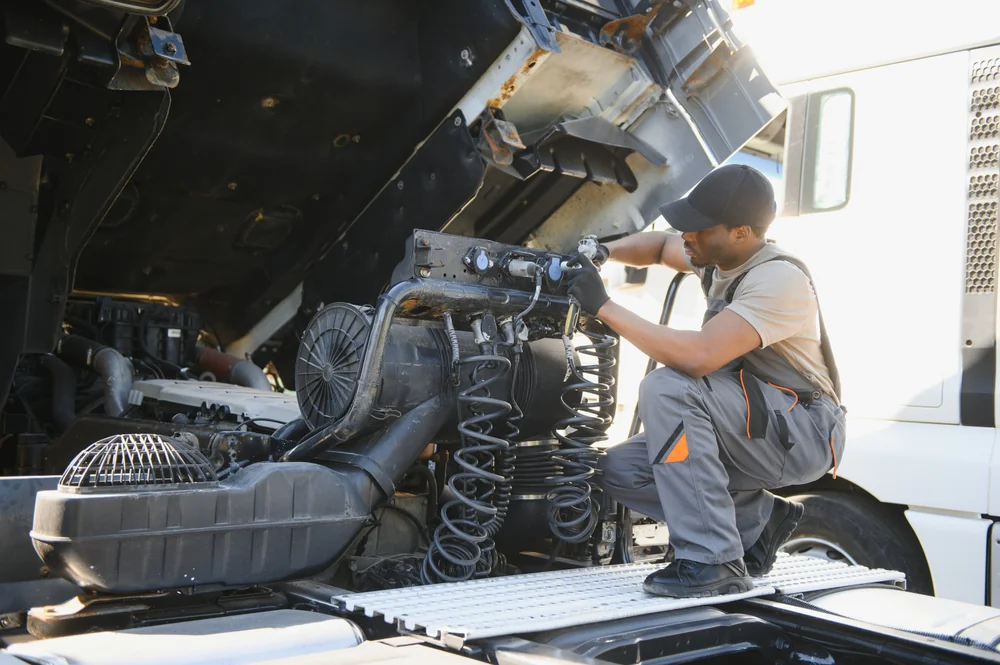
You already know the rules. Eleven hours of driving, inside a fourteen-hour window, after ten consecutive hours off. Simple enough on a normal day. But the moment your truck breaks down on the shoulder of I-75 in Wayne County, those numbers stop being abstract. The clock is still running. Your ELD is still logging. And every minute you spend waiting for a repair truck is a minute you can’t get back.
This post is about what actually happens to your HOS compliance during a breakdown — how to log it correctly, what your options are, and why the speed of your roadside response matters far more than most drivers stop to think about.
Commercial Truck Roadside Assistance and Your FMCSA Hours of Service Clock
Here’s the part that catches a lot of drivers off guard: the fourteen-hour window does not stop for a breakdown. Once your workday begins — the moment you do a pre-trip inspection, fuel up, or log into your ELD — that clock is running. It doesn’t matter that your truck isn’t moving. It doesn’t matter that you’re sitting on the shoulder of I-94 waiting for help. The window is live, and it keeps counting down.
This is why the speed of your commercial truck roadside assistance response isn’t just a comfort issue. It’s a compliance issue. A three-hour wait for a repair truck doesn’t just mean three hours of frustration — it can mean three hours carved out of a window you needed to complete your run. If you were already five or six hours into your day when the breakdown happened, you may not have enough legal driving time left to finish the load even after the truck is fixed.

Semi Roadside Assistance: How to Log Breakdown Time on Your ELD
The first question most drivers have when they break down is practical: what do I log this as? The short answer is that breakdown waiting time is generally classified as on-duty not driving. You’re responsible for the vehicle, you’re at the scene, and you’re waiting on a repair — that’s on-duty time under FMCSA rules, even though the wheels aren’t turning.
What you cannot do is log that time as off-duty to try to preserve your hours. ELDs record automatically based on engine and vehicle data. The breakdown is already on the record whether you manually adjust anything or not. Attempting to log the waiting period as off-duty when you were actually on-duty is a falsification risk — and it’s the kind of thing that shows up clearly during a DOT audit or roadside inspection review.
There is one legitimate option that drivers sometimes overlook: if you have a sleeper berth and you take a qualifying rest period during the breakdown wait, that time may count toward the split sleeper berth provision. Under FMCSA rules, you can split your required ten hours off duty into two qualifying periods — for example, a seven-hour sleeper berth rest and a three-hour off-duty break. If the breakdown is going to be a long one and you genuinely need rest, going into the sleeper berth and logging it correctly could help you bank time rather than burn it. But this only works if the rest meets the minimum thresholds, and it requires careful attention to the sequence and duration of each split.
When in doubt, document everything and talk to your fleet’s safety officer. Your ELD doesn’t lie, and it doesn’t wait for you to decide what to call the time. The log is being written in real time. That’s actually one of the strongest arguments for getting a fast, capable repair provider on the phone immediately — because every minute the repair takes is a minute that’s already being written into your record as on-duty not driving.
Road Side Assistance for Semi Trucks: What Happens When the Clock Runs Out Mid-Breakdown
Picture this: a driver breaks down on I-94 near the Romulus interchange at 10 in the morning. They have six hours left in their fourteen-hour window. The repair provider they call takes two and a half hours to arrive, spends another hour diagnosing the problem, and finishes the job around 1:30 PM. That’s three and a half hours consumed. They now have two and a half hours of on-duty time remaining in their window — not nearly enough to complete a run that requires four more hours of driving.
The load doesn’t get delivered. The driver is forced into a ten-hour restart. The carrier eats the late-delivery consequence, and depending on the freight, that could mean a missed customs appointment at the Ambassador Bridge, a spoiled reefer load, or a just-in-time parts delivery that shuts down a line at a Dearborn assembly plant. These aren’t hypothetical worst cases — they’re the real downstream effects of slow roadside response in a county where freight timing is tied to automotive production schedules and cross-border logistics windows.
Now run the same scenario with a provider who arrives in thirty minutes, diagnoses the problem quickly, and has the parts on the truck to fix it on-site in under an hour. The driver is back on the road by noon with four and a half hours remaining in their window. The load gets there. The record stays clean. That difference — two hours of preserved driving time — doesn’t come from paperwork or planning. It comes from calling the right provider fast.
Wayne County, MI Breakdowns: Why Local Response Time Changes Everything
Wayne County isn’t a typical freight market. You’ve got I-75, I-94, and I-96 running through some of the most commercially dense corridors in the Midwest. You’ve got the Ambassador Bridge handling a significant share of U.S.-Canada trade, Ford’s world headquarters in Dearborn, and the Detroit Metropolitan Airport in Romulus generating constant intermodal traffic. A breakdown anywhere in this county has time-sensitive consequences that go well beyond the inconvenience of being stuck on the shoulder.
Michigan winters make it worse. A January breakdown on I-75 at 2 AM — with temperatures in the single digits, diesel potentially gelling, and air lines at risk of freezing — is a safety event, not just an inconvenience. That’s the kind of situation where the difference between a provider who actually answers the phone and one who sends you to voicemail can matter in ways that have nothing to do with HOS at all.
Fleet Managers: How to Handle a Driver's HOS Situation During a Wayne County, MI Breakdown
If you’re managing a fleet and one of your drivers breaks down in Wayne County, the first thing you need to know is their current HOS status. How many hours are left in their fourteen-hour window? How much driving time do they have remaining? Are they close enough to their weekly sixty or seventy-hour limit that a long breakdown could force a thirty-four-hour restart?
These questions matter because they change how you respond. A driver with four hours left in their window and a two-hour repair ahead of them can still finish the run. A driver with ninety minutes left cannot — and the faster you recognize that, the faster you can reroute, reassign, or communicate with the customer before the delivery window closes. The ELD data is there in real time. Use it.
The second thing to know is what you’re asking the driver to do during the wait. If they have a sleeper berth and the repair is going to take several hours, it may be worth directing them to take a qualifying rest period rather than sitting on-duty not driving the entire time. A properly logged sleeper berth split can preserve more usable hours than just waiting the breakdown out on the clock. Document the breakdown event thoroughly — time it started, what was repaired, who performed the work, and when the driver was cleared to continue. That documentation matters if the logs are ever reviewed.
What you don’t want is a driver who’s anxious about their HOS status making decisions in the field without guidance. The combination of a clear communication protocol and a reliable roadside provider who can give you an accurate ETA and repair timeline is what keeps a manageable breakdown from turning into a compliance problem.
What to Actually Look for in a Truck Roadside Service Provider in Wayne County, MI
There’s a version of “roadside assistance” that means someone shows up with a consumer-grade tow truck and a phone full of shop numbers to call. That’s not what a commercial driver needs when they’re broken down on Telegraph Road at midnight with a reefer unit alarming and four hours left in their window.
What actually matters when you’re evaluating a provider for commercial work in Wayne County comes down to a few things that are easy to verify if you know what to ask. Can they come to you right now, or are they routing your call through a national dispatch center that may not have a local unit available? Do they carry diagnostic equipment and common replacement parts on the truck, or will they arrive, look at the problem, and then tell you they need to order a part? Can they handle your specific make — a Freightliner Cascadia, a Kenworth T680, a Peterbilt 389 — or are they generalists who added “semi trucks” to their website without building the capability to back it up?
We’ve been doing this work in Detroit and Wayne County for over forty years. Dr. Phillip Marin — who holds three PhDs in Diesel Engineering, Drivetrains, and Metal Alloys — leads our team personally, and his son Jason works alongside him. When you call 313-999-3088, you’re reaching people who know these roads, know these trucks, and know what it means to have a driver’s HOS clock running while they wait. Our mobile units come equipped with diagnostic computers, the parts needed for most common repairs, and the tools to handle everything from a broken leaf spring on the interstate to a Thermo King reefer unit that stopped cooling on a cross-border run.
We don’t charge extra for nights, weekends, or holidays. The estimate you get is the price you pay — customers have confirmed this in their own words, and we intend to keep it that way. If you’re an owner-operator building a contact list before a breakdown happens, or a fleet manager looking for a Wayne County provider you can actually count on at 3 AM in February, we’re worth a call before you need us.
HOS Compliance During a Truck Breakdown: The Bottom Line for Wayne County, MI Drivers
Your hours of service clock doesn’t care that you broke down. It started when your workday started, and it keeps running until you hit your mandatory rest. That’s the reality every commercial driver and fleet manager in Wayne County is working within — and it’s why the quality of your roadside response matters in ways that go well beyond getting the truck moving again.
Log your breakdown time as on-duty not driving unless you’re in a qualifying sleeper berth rest. Don’t try to adjust the record — your ELD already has it. And if you’re managing a driver remotely, get their HOS status before you start making decisions about the load.
The best thing you can do for your compliance record in a breakdown situation is get a fast, capable, local provider on the scene quickly. J&J Truck & Trailer Repair has been that provider for drivers and fleets in Wayne County for more than four decades. If you want to talk through a situation or just want to have our number saved before you need it, call 313-999-3088.