You pull over. The tire’s flat. Now what? If you’re a commercial driver or dispatcher working in Wayne County, MI, the next few minutes matter — not just for your schedule, but for your safety and your DOT compliance. The instinct is to get it patched and get moving. Sometimes that’s exactly right. Sometimes it’s the wrong call, and making it costs you more than the repair. Knowing the difference isn’t complicated, but it does require understanding a few things that most roadside services won’t take the time to explain. Here’s what you actually need to know about truck tire repair — when it works, when it doesn’t, and what a proper fix looks like.
Semi Truck Tire Repair: What Makes a Roadside Fix Legitimate
Not all tire repairs are created equal. A plug jammed in from the outside might hold air for a few hundred miles — but it’s not a DOT-compliant repair for a commercial vehicle, and it won’t pass a roadside inspection. The industry standard, set by the U.S. Tire Manufacturers Association, requires that the tire be removed from the rim, inspected from the inside, and repaired with a patch-plug combination that seals both the puncture channel and the inner liner.
That last part — removing the tire — is where a lot of roadside “repairs” fall short. If a tech plugs your tire without taking it off the wheel, they haven’t inspected the interior. And the interior is where the real damage hides.
What Truck Tire Service Should Actually Include
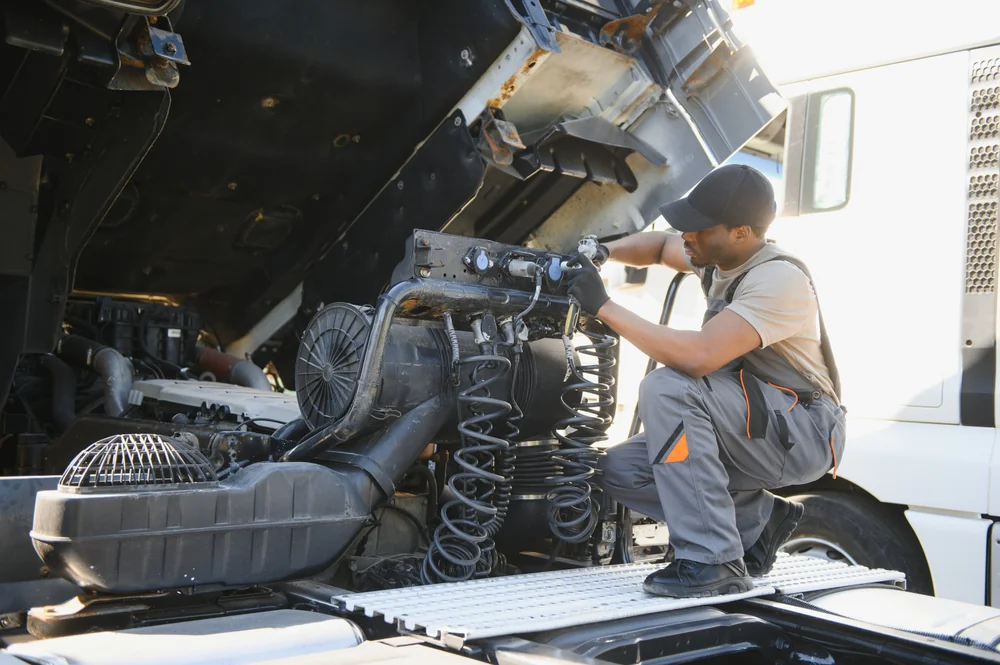
A proper commercial tire repair follows a clear process. The tire comes off the rim. We inspect the inside for hidden damage — separated belts, liner tears, bead area issues — that wouldn’t be visible from the outside. If the damage is repairable, a patch-plug combo is applied: the rubber stem fills the puncture channel, and the patch bonds to the inner liner. Then the tire goes back on, gets torqued to spec, and is inflated to the correct pressure.
That’s not a complicated process, but it requires the right equipment and the knowledge to use it. A bead breaker, a proper repair kit, and a torque wrench aren’t optional — they’re what separates a real repair from a temporary fix.
Here’s why this matters for commercial drivers specifically: a tire inflated below 50% of its maximum pressure is an automatic out-of-service condition under FMCSA regulations. A plug-only repair that slowly leaks, or a repair that fails to address hidden damage, puts you right back in that situation — except now you’re at highway speed with a loaded trailer.
The USTMA also limits repairs to a maximum of two per tire, and only in the tread area. No overlapping patches. No sidewall repairs. No exceptions.
The repair eligibility rules are strict for good reason. A puncture must be in the tread area, not the shoulder or sidewall. The injury can’t be larger than a quarter inch in diameter. The tire can’t have been run flat — even briefly. And steer tires carry additional federal restrictions on where and how repairs can be made. If any of those conditions aren’t met, the tire needs to come off the truck, not get patched.
Can a Semi Truck Tire Be Repaired After Running Flat?
This is the question most drivers don’t ask until it’s too late. The short answer is: probably not, and here’s why.
When a commercial tire loses pressure and the vehicle keeps moving — even for a short distance — the sidewall collapses under the weight of the load. That flexing generates heat, and heat destroys the internal structure of the tire in ways that don’t show up on the outside. The tread can look intact. The sidewall might not have any visible cracking. But inside, the belts have separated, the liner is compromised, and the structural integrity is gone. There’s no patch that fixes that.
This is one of the most expensive mistakes commercial drivers make — not the blowout itself, but the 200 yards they travel before pulling over. A tire that might have been a straightforward repair becomes a full replacement the moment it’s run flat. And a replacement that could have waited until a scheduled stop becomes an emergency roadside call.
The rule of thumb is simple: if you felt the tire go and pulled over immediately, there’s a reasonable chance it’s repairable depending on where the damage is. If you drove on it — even to get off the highway — the odds drop significantly. Only a proper interior inspection can tell you for certain, which is exactly why the “take it off the rim first” standard exists.
Wayne County, MI’s roads don’t make this easier. The freeze-thaw cycle that Michigan goes through every winter tears up pavement in ways that are hard on commercial tires. A pothole on I-75 or a rough patch on I-96 can cause a sudden pressure loss that catches a driver off guard. The faster you pull over, the better your options.
Semi Tire Shop vs. Mobile Repair: Which One Do You Actually Need?
When a tire fails on the road, the question isn’t just whether it’s repairable — it’s who’s doing the repair and where. A lot of drivers assume that mobile roadside repair is a shortcut, and that a proper fix has to happen in a shop. That assumption is wrong. The same USTMA and TIA standards apply whether the repair happens in a bay or on the shoulder of I-275. What matters is whether the tech has the right equipment and actually follows the process.
For commercial drivers in Wayne County, MI, a qualified mobile repair isn’t a compromise — it’s often the faster, more practical option. You’re not waiting for a tow. You’re not paying for a shop visit on top of the repair. And if the tech is stocked with the right parts, you’re back on the road without losing half your day.
When Should You Call a Tire Shop for a Semi Truck Instead of Waiting for Roadside?
There are situations where a mobile repair is the right move, and situations where the truck needs to go to a shop. Knowing which is which saves time and money.
Mobile repair makes sense when the damage is a clean puncture in the tread area, the tire wasn’t run flat, and the size and location of the injury fall within repairable limits. A qualified mobile tech with the right equipment can handle that repair on-site, properly, in compliance with DOT standards. You don’t need a shop for that.
You do need a shop — or at minimum a full replacement on-site — when the damage is in the sidewall, when the tire has been run flat and the interior is compromised, when the puncture is larger than a quarter inch, or when the tire has already been repaired twice. None of those situations are patchable, regardless of how the tire looks from the outside.
There’s also the question of tire position. Steer tires are held to stricter federal repair standards than drive or trailer positions. A repair that’s acceptable on a drive axle may not be compliant on a steer axle. A tech who doesn’t know the difference — or doesn’t bother to check — is putting you in a position where a DOT inspection could put your truck out of service. Each major tire violation costs 8 CSA BASIC points, and those add up fast for owner-operators and fleets alike.
The bottom line is that mobile repair and shop repair aren’t competing options — they’re different tools for different situations. What matters is that whoever shows up to help you actually knows which situation you’re in, has the equipment to handle it properly, and won’t cut corners because it’s faster.
What Wayne County, MI Truck Drivers Should Know Before a Blowout Happens
Wayne County, MI sits at the intersection of some of the busiest commercial freight corridors in the Midwest. I-94, I-75, I-96, I-275, and I-696 all run through or along the county, and the traffic on those roads includes everything from local drayage to cross-border freight heading to and from the Ambassador Bridge. That volume, combined with Michigan’s notoriously rough roads and the pressure swings that come with Great Lakes winters, makes tire failures a routine reality for commercial drivers in this area — not a rare event.
Cold weather alone is worth understanding. For every 10-degree drop in temperature, a tire loses roughly 1 PSI of pressure. In a Michigan January, that math adds up fast. A tire that was properly inflated in a warm terminal can be significantly underinflated by the time it hits the highway in the early morning. Underinflated tires run hotter, wear faster, and are far more likely to fail — especially under load.
Spring is its own problem. The pothole season that follows Michigan’s freeze-thaw cycle is hard on every vehicle, but commercial trucks feel it more than most. A pothole that barely registers in a passenger car can knock a steer tire off its bead or cause an immediate blowout on a loaded drive axle.
The practical takeaway is this: having a plan before a breakdown happens is worth more than scrambling to find help after one. Knowing who to call, what information to give them (your exact location, the axle position of the damaged tire, whether you were able to pull fully off the road), and what to expect from a proper repair makes the whole situation less stressful and faster to resolve.
We cover all of Wayne County, MI — I-94, I-75, I-96, I-275, I-696, and the surrounding roads — and our mobile units are stocked with tires, rims, and the parts needed to handle most repairs on-site. Our rate is the same at 3 AM on a Sunday as it is on a Tuesday afternoon. No night surcharges, no weekend premiums. When you call, you know what you’re getting.
Truck Tire Repair in Wayne County, MI: The Short Version
A repairable tire has a clean puncture in the tread area, no larger than a quarter inch, that hasn’t been run flat. The repair has to come off the rim, get inspected from the inside, and be fixed with a proper patch-plug combination — not a plug alone. Anything outside those parameters is a replacement, not a repair.
If you’re not sure which situation you’re in, that’s exactly what an on-site inspection is for. A qualified tech can tell you in minutes whether the tire is salvageable, what the repair involves, and whether it meets DOT standards for the axle position it’s on.
If you’re broken down in Wayne County, MI and need a straight answer — not a runaround — call J&J Truck & Trailer Repair at 313-999-3088. We’ll come to you, assess the damage properly, and give you an honest answer about what it takes to get you back on the road.